Conditions We Treat
Massage for Multiple Sclerosis in NYC
Multiple sclerosis damages nerves, but much of what makes daily life harder happens downstream: muscles that misfire, excess tone, joints pulled out of position, and other muscles overworking to compensate. Bodyworks DW’s licensed medical massage therapists work on that downstream layer, to keep you moving better for longer alongside your neurologist’s care.
- Available in FiDi & Midtown West – open 7 days a week
Causes
What's Going On With Multiple Sclerosis?
- More people are living with a multiple sclerosis diagnosis than once counted. A 2019 study put the US figure at nearly 1 million (Wallin et al., Neurology 2019), more than double the earlier estimate of about 400,000 (StatPearls – NIH), and worldwide prevalence has risen in every region since 2013 (Atlas of MS, 2020).
- Multiple sclerosis damages the nerves that carry signals between the brain and the body. Its cause isn’t fully established, and is likely a mix of genetic predisposition and environmental triggers.
- When signals arrive unreliably, muscles misfire. Some carry too much tone, others go weak, and the two can work against each other instead of together.
- The body compensates. Stronger muscles take over, joints get pulled out of position, and strain spreads into areas the disease itself never reached.
- Common experiences include one-sided weakness, drop foot, reduced fine motor control in a hand, a restricted shoulder, and fatigue that arrives early in the day.
- Symptoms often come in cycles, with flares and calmer stretches in between.
Bodyworks DW frames multiple sclerosis as a nervous-system condition with a muscular and postural cascade we can work on, even though the disease itself is not ours to treat.
Watch: Byron Isaacs, bassist for The Lumineers, on touring with multiple sclerosis, followed by his first session, from Episode 1 of our series The Challenge of Being You. Read the write-up: What massage can and can’t do for multiple sclerosis.
Related conditions: Autoimmune Disorders · Chronic Stress & Burnout · Neck Pain · Hip Pain
How we treat
How Bodyworks DW Treats Multiple Sclerosis
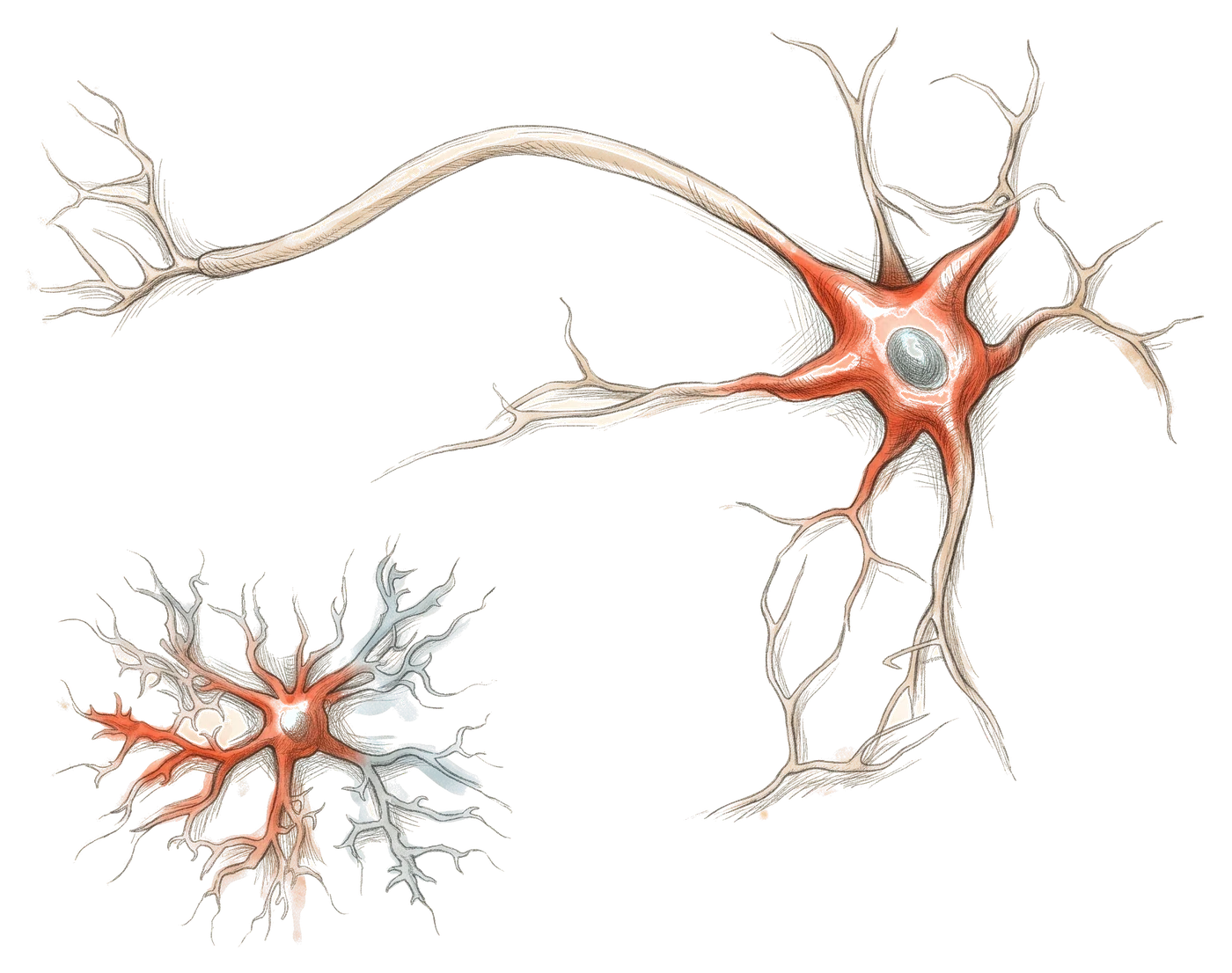
A nerve cell. In multiple sclerosis, the protective coating around nerves like this one is damaged, so signals reach the muscles unreliably. Massage works on what happens downstream, in those muscles. Illustration adapted from Blausen Medical (2014), CC BY 3.0, via Wikimedia Commons.
Whole-Body Evaluation
We start standing: stance width, foot angle, arch height, pelvic tilt, knee position, and where the head sits over the shoulders. Then we look at which muscles are misfiring, which are overworking to make up for them, and how much energy you have that day, because fatigue changes how much work is useful.
Targeted Myofascial & Deep Tissue Work
The work often starts away from the symptoms. When one side of the body is weak, the other side usually carries the load, and releasing that side can take strain off the symptomatic one. We build support from underneath (psoas and hip flexors, pelvis, ribs, upper back) before working the neck directly. In the legs we balance a strong quadriceps against a weaker hamstring so the leg can swing through a step. Pressure is adjusted to fatigue and sensitivity.
Repetition, So the Nervous System Learns
Hands-on work gives the brain a new pattern to recalibrate to, and that change holds when it’s repeated before the old pattern returns. That’s why we work in series, ideally within about two weeks of the last session, and why shorter sessions more often usually do more than long ones spread far apart.
Care as Part of a Team
Massage is one part of the picture. Disease management belongs with your neurologist, and strength and loading belong with a physical therapist, for example rebuilding a weakened shoulder. We coordinate with both, and we’ll tell you when something needs their hands rather than ours.
Therapists for Multiple Sclerosis
David
Owner/Founder

Jessamyn
Lead Massage Therapist

Andrew
Lead Massage Therapist

Briana
Lead Massage Therapist

Thom
Lead Massage Therapist

Book now
Book your Session for Multiple Sclerosis
What to Expect
A Progressive Plan
Session 1
Evaluation, easing the compensating tension that’s doing the most damage, and one simple home exercise to start the pattern changing.
Sessions 2–4
Reinforce the new pattern: leg swing, hip and rib support, and unloading the neck and shoulders, before the old habits settle back in.
Ongoing
Spacing set by how long the changes hold for you, with lighter, shorter sessions during flares.
Ready to start feeling better?
See times
Care
Home Care That Helps Between Sessions
Home care should be simple enough to do on a tired day.
- A psoas reset: lie on the floor with your legs resting on a chair, hips and knees at about 90 degrees, for 5 to 8 minutes. No phone.
- Pacing that spends energy on what matters most that day
- Breathing and rib-expansion resets to calm the nervous system
- The strengthening program from your physical therapist, alongside our work

Testimonial
What Our Clients Say
Pricing & wellness wallets
Book now. Pay after.
Or load a Wellness Wallet and get extra credit.
Book now · pay after
Book your session
No prepay. A card on file holds your time; you pay after your session.
Senior
Lead
Owner
60 minutes
$175
with a Senior Therapist
90 minutes
$250
with a Senior Therapist
Wellness Wallets
Load credit, get extra
Use it on any 60- or 90-min session at either studio.
Recommended
$800
$920
Covers ~3–5 sessions
+$120
$1,400
$1,650
Covers ~5–10 sessions
+$250
Before your first visit only
$550
$600
~3 sessions with any Senior or Lead therapist
+$50

Frequently Asked Questions
Have more questions? Get in touch
Is massage good for multiple sclerosis?
Massage can help with what multiple sclerosis sets in motion: excess muscle tone, muscles that misfire, and the compensation that pulls joints out of position. Massage therapy cannot treat multiple sclerosis itself. A small 2016 pilot study of 24 people with multiple sclerosis found significant improvements in fatigue and pain after six weeks of weekly massage. The gains tend to hold when sessions are close enough together for the nervous system to learn the new pattern.
Can massage slow multiple sclerosis progression?
Massage has not been shown to slow multiple sclerosis itself. What it may slow is the loss of function that builds up around the disease: muscles weakening from disuse, joints stiffening, and compensation spreading into new areas.
Can a massage therapist tell if I have multiple sclerosis?
No. Diagnosis belongs to a neurologist. What we can notice is a pattern: symptoms that come and go in cycles, and that don’t respond to a series of sessions the way muscular problems usually do. When we see that, we’ll suggest you see a doctor.
Do I need a doctor's note for massage with multiple sclerosis?
No. Under New York State licensure, massage therapists assess whether massage is safe for you and refer out when necessary. See the NYS Office of the Professions FAQ.
How often should I get massage for multiple sclerosis?
Work in a series rather than one-off sessions, ideally returning within about two weeks of the last one. Three sessions a week or two apart usually do more than six spread a month apart, and 60-minute sessions more often usually beat 90-minute sessions less often.
Are there precautions for massage with multiple sclerosis?
Yes. Pressure and session length are adjusted for fatigue and sensitivity, and sessions are lighter during a flare. Many people with multiple sclerosis are sensitive to heat, so we avoid hot treatments. New or suddenly worsening symptoms belong with your neurologist first. Full list: NYS massage therapy precautions.
Resources
Explore our Relief Library

Podcast & Case Studies
Massage for Multiple Sclerosis: What it Can and Can’t Do
David Weintraub
- Feb 17, 2026

Podcast & Case Studies
What I Could See and What I Couldn’t Say: Byron Isaacs’ Multiple Sclerosis DiagnosisDavid Weintraub
- Feb 17, 2026