Conditions We Treat
Massage for Knee Pain, ACL Recovery & Patellar Tracking Issues in NYC
Knee pain can stall your movement, workouts, and daily life—especially after an ACL injury or when the kneecap isn’t tracking smoothly. Our licensed medical massage therapists help restore balance through the entire leg and hip system, reduce compensatory tension, and improve the mechanics your knee depends on.
- Available in FiDi & Midtown West – open 7 days a week
Causes
What’s Going On With Knee Pain?
- Knee pain affects ~25% of adults, and patellofemoral pain syndrome (PFPS/runner’s knee) makes up 25–40% of sports-medicine knee complaints (StatPearls – NIH 2023).
- The knee is heavily influenced by the hips, pelvis, low back, ankles, and feet. Loss of mobility or alignment in any of these areas forces the knee to absorb extra strain.
- ACL injuries often leave long-lasting tension in the quads, hamstrings, calves, and hips—even after surgery—limiting mobility and slowing recovery.
- Patellar tracking issues happen when the kneecap glides off-center, creating friction or sharp pain with stairs, squats, or running. Tight lateral tissues and weak medial stabilizers commonly drive this.
- Meniscus tears and wear. Shock-absorbing discs on top of the tibia, softer than the surrounding ligaments — so they usually give out first, and a tear can progress toward bone on bone.
- Osgood-Schlatter. Teenage growth-spurt pain below the kneecap, when the femur lengthens faster than the muscles around it adapt.
- Osteoarthritis. Sustained compression wears cartilage, and cartilage loss brings arthritic change in the bone. More common with age.
At Bodyworks DW, we treat knee pain as a full-chain issue. Restoring balance in the hips, ankles, ribcage, and feet reduces unnecessary load on the knee and improves long-term function.
Knee Pain Explained – Video
Related conditions: See also our Hip Pain, Low Back Pain, and Ankle & Foot Pain pages.
How we treat
How Bodyworks DW Treats Knee Pain
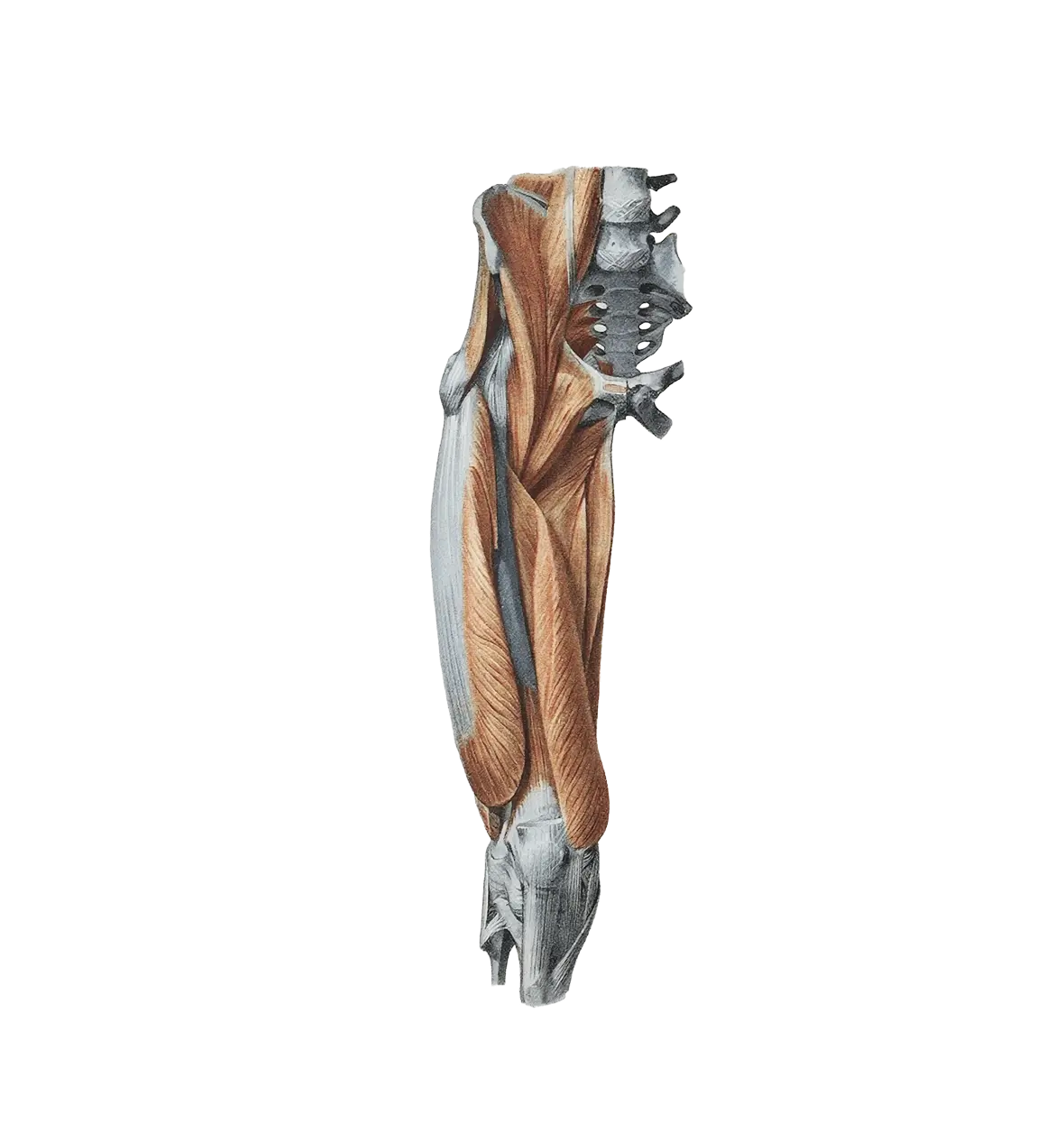
As you can see from this image, the muscles affecting the knee just from above are quite complex. Getting them to release from each other to allow the knee to align and function properly requires detailed knowledge of their placements and precision technique, not a steamroller deep tissue approach. Anatomy Plate (Braus, 1921)
Whole-Body Evaluation
A brief intake and movement check to find what’s driving your knee pain—tight quads, hamstrings, and adductors, limited ankle mobility, or hip tension—so we can maximize hands‑on time.
Targeted Myofascial & Deep Tissue Work for Mobility
Session 1 starts with releasing hips, quads, IT band, calves, and ankles to create slack around the knee. Only after the surrounding chain is balanced do we work locally through the smaller stabilizing muscles around the knee—structures like the short head of the biceps femoris, plantaris, and popliteus that often become locked short and overlooked.
ACL Post-Operative Support
Once cleared by your surgeon or PT, we help restore tissue glide, reduce scar tension, and improve mobility in the surrounding muscles. This complements your PT’s strengthening plan and helps prevent compensatory overload.
Patellar Tracking Correction
We balance the lateral and medial structures around the knee—releasing TFL/IT band tension, improving VMO engagement, and restoring smooth patellar glide. Knee pain often shows up at the kneecap, but the real driver is frequently below it: when the ankle or foot loses mobility, the lower leg rotates outward to compensate. Improving foot and ankle mechanics lets the lower leg return to neutral, allowing the patella to track correctly again. It seems “magical,” but it’s simply biomechanics.
Progressive Plan That Builds on Each Session
As alignment improves, we integrate hips, ribs, feet, and even gait mechanics to help your knee move efficiently in daily life.
Therapists for Knee Pain (ACL Post‑Op, Patellar Tracking)
Joao
Senior Massage Therapist
Andrew
Lead Massage Therapist

Yvonne
Lead Massage Therapist

Jovaughn
Senior Massage Therapist

Rebecca
Lead Massage Therapist

Christopher
Lead Massage Therapist

Ann
Lead Massage Therapist

Nichole
Lead Massage Therapist
Nick
Lead Massage Therapist
Leela
Lead Massage Therapist
Kelly
Lead Massage Therapist

Ben
Lead Massage Therapist

Jessamyn
Lead Massage Therapist
David
Owner/Founder

Atsuhiko
Lead Massage Therapist
Shiho
Lead Massage Therapist

Thom
Lead Massage Therapist
Briana
Lead Massage Therapist
Book now
Book your Session for Knee Pain (ACL Post‑Op, Patellar Tracking)
What to Expect
A Progressive Plan
Session 1
Reduce tension in hips, quads, IT band, calves, and ankles to decrease strain on the knee. Expect easier bending with noticeably less catching, pressure, or pinching.
Sessions 2–4
Integrate ribcage mobility, pelvic balance, and ankle mechanics to reinforce clean, efficient knee tracking.
Sessions 5–8+
Reinforce whole-body alignment—from the feet up through the hips, ribs, shoulders, and neck—to maintain knee stability and prevent flare‑ups.
Ready to start feeling better?
See times
Care
Home Care That Helps Between Sessions
We’ll teach simple, effective strategies such as:
- Quad, calf, and hip-flexor mobility drills
- IT band and lateral chain lengthening (safe techniques)
- VMO-focused activation patterns
- Rib expansion and breathing resets for better gait mechanics
- Foot posture and arch-strengthening strategies
For example, here’s a helpful video demonstrating a shoulder girdle reset technique:

Testimonial
What Our Clients Say
Pricing & wellness wallets
Book now. Pay after.
Save up to 20%.
Pay after your session—no prepay.
New here? Select “New Client Massage” to get $25 off your first visit.
Add a Wellness Wallet before your first session or within 7 days after to get up to 20% bonus credit.
START HERE
Book your session
No prepay—card on file to hold; pay after your session. Choose “New Client Massage” to get $25 off your first visit with select therapists.
Senior
Lead
Owner
$25 first-visit credit on Senior & Lead therapists
60 minutes
$160
/ with Senior Therapist
90 minutes
$230
/ with Senior Therapist
First wallet bonus
Save with Wellness Wallets
First time buying a Wellness Wallet? You qualify for our best bonus. New to Bodyworks? Buy before your first session to use it on that visit.
$800
Get $120 bonus
Covers ~3–5 sessions
15% bonus credit
$1400
Get $250 bonus
Covers ~5–10 sessions
17.5% bonus credit

Frequently Asked Questions
Have more questions? Get in touch
How do I know if my knee pain is coming from tracking issues?
Pain around or behind the kneecap—especially with stairs, squatting, or running—is often related to tracking imbalance. Tight lateral structures and weak medial stabilizers commonly contribute. Often, the real long‑term solution comes from mobilizing the ankle below and the hip above the knee.
When can I receive massage after ACL surgery?
Typically once your surgeon or PT clears you—often 6–12 weeks depending on healing. We avoid direct work over unhealed incisions and tailor techniques to your recovery stage.
What makes Bodyworks DW’s approach different?
We address the full kinetic chain—hips, ribs, feet, gait mechanics—not just the knee itself. This helps reduce strain and improve long-term stability.
How many sessions will I need?
Most clients feel improvement in 1–2 sessions, with deeper, lasting changes over 5–8 sessions.
Are there precautions for knee massage?
Yes. Acute inflammation, recent surgery, nerve symptoms, or medications affecting tissue integrity require caution and modified pressure.
Full list: NYS Massage Therapy Precautions
Resources
Explore our Relief Library
Guides
Types of Massage Explained: What Each One Is For and How to Choose
David Weintraub
- Sep 15, 2026
Guides
Massage for Sports Injuries: What is Scar Tissue and How Can Massage Help As We Age?David Weintraub
- Oct 14, 2020

Guides
Doing Physical Therapy? Massage Therapy Can Vastly Improve Results!David Weintraub
- Dec 14, 2020