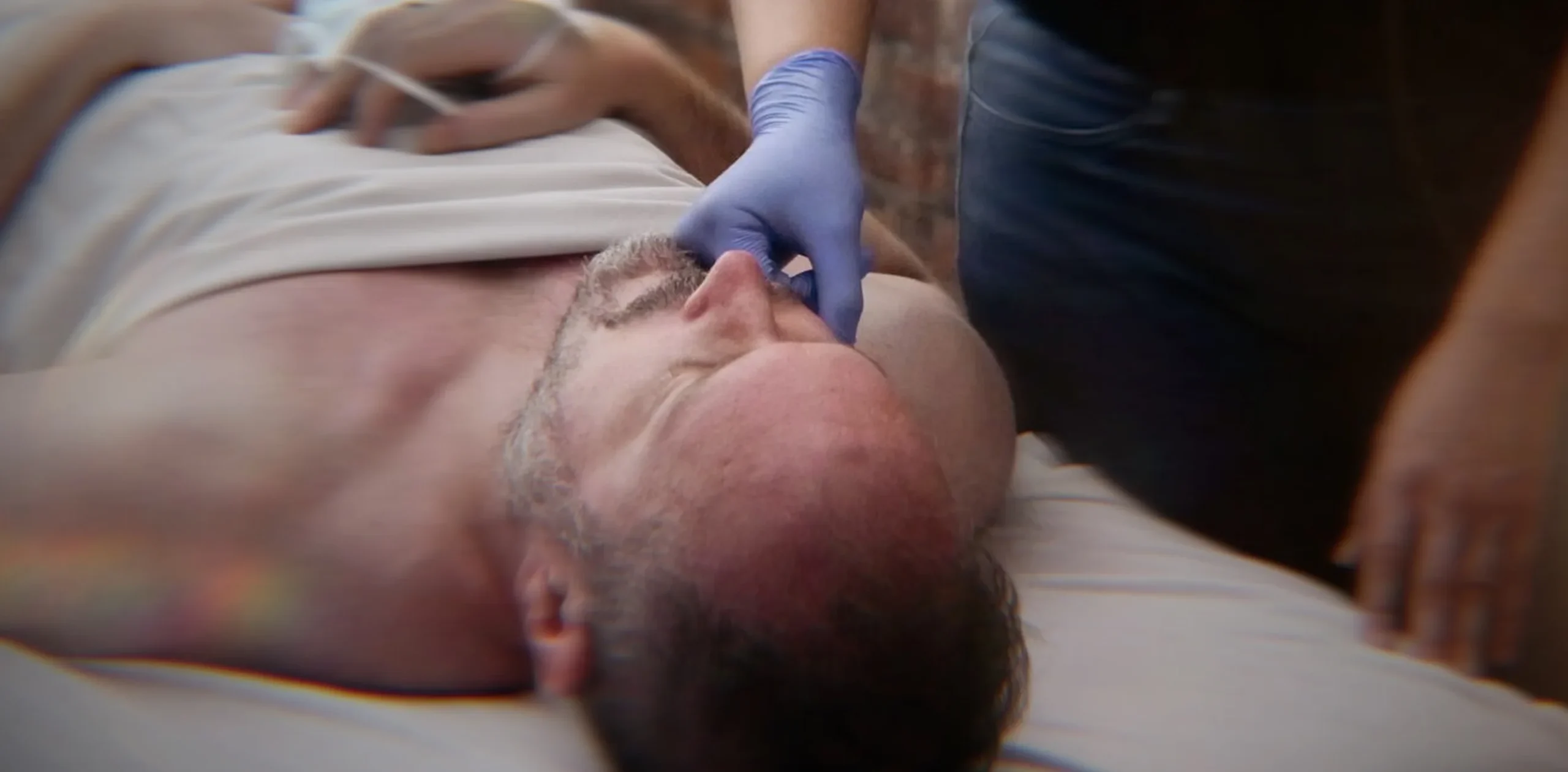
The month before the diagnosis
It started the night of a gig. Both feet numb, which was strange enough that he ruled out the obvious explanation on the spot: he’d moved his wallet to his front pocket for the drive specifically to avoid it.
By morning it hadn’t gone. It had moved up into his calves and shins, and it was climbing symmetrically, both sides at once.
His GP sent him straight to a neurologist. The neurologist had a ten-day wait. During those ten days the numbness reached his waist and he lost the sensation of urinating. The night before the appointment, the office called to cancel — the doctor was going out of town.
His wife kept her head, and took him to NYU instead.
The neurologist he saw there ran what Byron now knows is a fairly standard eye test for MS, and seems to have suspected it from early on. But there was a complication he didn’t share at the time: the symmetry was wrong. Symmetrical, both-sides-at-once presentation is not typical of MS. It is more typical of ALS.
He never said the word ALS out loud until the MRI had confirmed MS.
Byron felt the first numbness on 15 November. The MRI was on 17 December. A month of not knowing, most of it spent waiting.
The MRI found lesions in both brain and spine. The active ones were in his spine. The ones in his brain were old — which prompted the question of whether he’d ever had anything like this before. He had, once, years earlier: a bad flu, followed by weeks of numbness through his left arm and his ring and little fingers. The kind of thing that gets attributed to a pinched nerve in the neck, because usually it is. That had almost certainly been an earlier attack, and they were looking at what it left behind.
What was actually happening, and why the steroids worked
Your nerves are wrapped in a covering called the myelin sheath. In MS, the immune system decides that covering is a foreign object, and the lymphocytes — white blood cells — attack it.
The sheath swells. It swells outward, and it also swells inward, and the inward swelling presses on the nerve itself.
That’s why corticosteroids can reverse the symptoms. They aren’t repairing anything. They bring the inflammation down, the pressure comes off the inside, and the nerve can start firing again.
Byron was struggling to walk by this point and was, in his words, close to a wheelchair. Stairs were nearly impossible. They gave him corticosteroids and it worked — back to about 95% of where he’d been. Never quite 100%, but close enough to go back to his life on daily medication.
There was something else going on in that treatment he didn’t know at the time: they were also finding out which kind of MS he had. A massive attack like that responding well to steroids tells you something. A progressive presentation might not have improved much at all.
Six years passed. Past the five-year threshold, the odds of another attack drop considerably. At the six-year mark he had one anyway, and came back to about 85%. That one hit only his left side — the first time anything had been one-sided. That was 2019.
The effects of steroids shrink as the disease progresses and the myelin accumulates damage. He still responds somewhat. What he gets back doesn’t hold the way it used to.
“Of all the things it could be, you want it to be MS”
Here’s the part I’d half forgotten until he told the story back to me.
Weeks before that first attack, Byron came to see me about numbness in his feet, in the window between his GP appointment and the neurologist. And I remember thinking: bilateral is not good.
I told him what I hoped it was — nerve impingement in the lumbar spine, which is common, which I see constantly, and which I have genuinely helped people with when neuropathy in the feet turned out to be coming from the low back.
Then I told him that if the session didn’t help, he should run, not walk, to the hospital.
Because the list of things it could have been included some considerably worse items. Set against Parkinson’s or ALS, MS is the one you’d choose. Not because it’s a small thing — it obviously isn’t — but because it has real treatment options now, and it is not the more or less fixed sentence people assume when they hear it. To anyone dealing with ALS: I’m sorry. That is a much harder road.
The medication is what let Byron do something that thirty years ago would have finished him quickly, which is tour the world, do a physically punishing job, and sleep badly in a different city every night.
Four days later: what actually held
This session came four days after the first one. That gap is deliberate. The results come from stacking sessions close together — five to eight of them, less than two weeks apart, and twice a week where we can manage it.
What held: his neck. Lasting improvement, and the most notable change from session one, which is striking given how little we touched it.
What didn’t: the shoulder range of motion lasted about a day. The psoas tightened back up. Neither is surprising.
But Byron brought something back that I hadn’t spotted, and it’s the useful kind of observation only the person living in the body can make. He’d worked out that his cane was part of what was tightening his shoulder, and that the shoulder was then pulling his neck out of alignment. He leans on it hard — sometimes for the leg, sometimes just for stability in Brooklyn foot traffic.
That fits exactly with the rightward head shift we found in the first session.
A hypothesis, not a programme
I asked him to try the cane in his left hand and see what happened.
He explained, reasonably, why that’s difficult: a cane works as a tripod, weak leg and cane on the outside supporting each other while the strong leg swings through. Put it on the other side and the geometry breaks. And his left arm is weak enough that it may not hold him anyway.
He said he’d try it because I asked. I told him not to treat it as the right answer.
That’s the actual difference between this and a spa with a routine everybody gets. I look at what’s out of alignment, work out what might be affecting what, and form a hypothesis to test. The first session was itself a test — improve the head position, get the hip sockets moving, see what else changes. Some of it did.
Today’s hypothesis was the side body. And I say that knowing I might throw it out entirely if he walked in presenting differently, which happens.
He did the homework once
The homework from session one was feet up on a chair. He managed it once, and told me so.
My answer was: good job.
That isn’t me being nice. The work creates the possibility of a different pattern; the homework is what locks it in — and habits are genuinely hard, so anything in the right direction gets reinforced rather than corrected.
His reason for only managing it once was a real one: his Brooklyn apartment doesn’t have floor space, and clearing some takes actual effort. Which turns out to be the more useful problem, because it’s solvable. He’s now planning to permanently move some furniture to make a floor-exercise space.
The general principle is worth having:
To build a habit, remove the friction in front of it. To break one, add friction deliberately. Your brain will always do the easiest available thing. Make the thing you want easier than the thing you don’t.
The failure wasn’t discipline. It was a piece of furniture.
Why the sides of the body
This session was aimed at all four ball-and-socket joints — both shoulders, both hips — worked from a side-lying position, about thirty minutes per side.
We all get stuck in front-and-back thinking. We fold forward all day, everything at the front tightens, and then the back tightens to counteract it. Almost nobody thinks about the sides. Open the sides and you create space for the front and back to relax into.
Side-lying has a second advantage: he can’t receive it passively. His nervous system has to keep him balanced on the table, so as each thing opens up, his cerebellum has to recalculate how to stay upright. Every release forces a rebalance. If you sleep on your side, incidentally, this session is a very good one.
The shoulder, and the jacket
I’d been thinking about his left shoulder since the first session. My read is bursitis in the joint, presenting something like a mild frozen shoulder — not a severe case, but enough to explain why it isn’t improving quickly or easily. The shoulder girdle moves reasonably well. The joint is locked up.
What that meant in daily life came out later, and it’s the detail that has stayed with me:
“My shoulder had been so frozen that I would use the end of my cane to push my jacket off, because I couldn’t get it off.”
This is what I’d want people to take from the whole episode. Clients with a shoulder in that state are not asking me whether they can get back to the gym. They’re asking whether they can put a shirt on without pain. Shaving, shoes, jackets, standing up. When someone gets that back, the reaction is bigger than anything a personal best produces.
The diaphragm, and why your exhale isn’t a thing you do
The clearest explanation in this episode, and it applies to everyone.
Your diaphragm cuts across your middle roughly like a jellyfish. At the end of an exhale it’s at its most domed. When you inhale it flattens down toward your feet.
Here’s the part almost nobody knows. Unlike your biceps and triceps, which work in opposing pairs, your diaphragm has no exhaling muscle. You have a set of muscles that inhale, and then you let them go. That’s the exhale.
So the inhale and the exhale are not equivalent actions. The inhale is the action. The exhale is the undoing of the action — a balloon being let go, not a balloon being squeezed.
Which means that whenever you control air on the way out, as you must to sing or speak, you’re holding the diaphragm tight the entire time. You never fully let it relax. Byron makes his living with his voice and his hands, and you could hear it: a small wheeze at the end of each exhale, a diaphragm not quite willing to let go.
One correction to the usual advice while we’re here: breathe into your ribs, where your lungs actually are, rather than pushing your belly out.
None of this contradicts controlled breathing for anxiety, incidentally. A four-count in, hold, four-count out is good emotional regulation. It just isn’t how you should breathe the rest of the time.
Cooling down, and why fascia sets like it’s cooling in a mould
The most broadly useful thing in this session, and it has nothing to do with MS.
When you’re active — on stage, in the gym, running — your muscles heat up, and so does your fascia, which softens as it warms.
If you sit down immediately afterwards, it cools into the shape you’re sitting in. And sitting shape is excellent for sitting and poor for everything else.
Ten minutes of walking around afterwards is enough to prevent it. Not a workout, not a stretching routine. Walk, get some water, keep moving gently while everything cools with you in motion rather than folded into a chair.
Most people finish at the gym and get straight onto a cold subway car for forty-five minutes, then wonder why their back has seized by the next morning. This is a large part of why.
What changed
Standing him up at the start: the external rotation in his feet had come in, his feet were more parallel, his head was closer to neutral, and the left knee that had been badly bent was holding most of what it gained in session one. Some of session one had stuck.
By the end, what he reported was the mid and lower back opening, and easier breathing. Then a smaller thing that isn’t small: bending down to put his shoes on had been hurting, and he’d assumed that was about his weight. It wasn’t. He’d been back-bending the whole time and couldn’t curl through the mid-back to fold forward. That came back in this session.
And earlier, mid-session, lying on his side:
“It actually feels normal to lie on this side for the first time in six months at least.”
Where this fits
If you’re here because you searched for something that sounded like what’s happening to you, please take the practical part of Byron’s story rather than the diagnostic part: he went to his GP immediately, and when the specialist appointment fell through, he went to a hospital the same day. Ascending numbness on both sides is a see-someone-now symptom, not a wait-and-see one. This post is not a diagnosis and neither is anything else you’ll read tonight.
If you want the broader picture of what manual therapy can and can’t do in a condition like this, that’s episode one, and the distinction it turns on is the useful part.
Episode 1: What massage can and can’t do for MS
Massage therapy and autoimmune disorders
We’re in FiDi and Midtown West. If you’re managing something in this territory and want to talk about what’s realistic, book a 60- or 90-minute visit and tell us what’s going on.
David Weintraub, LMT – Owner, Bodyworks DW Massage Therapy
Resources and support
If you or someone close to you is navigating life with MS, psoriatic arthritis or another autoimmune condition:
Byron’s music
Everything above is a man having a hard time with his left hand. This is what that hand does when it works. Bass and vocals with The Lumineers, his own band Lost Leaders, and a founding role in Ollabelle before that. Just to mention a tiny part of his career…