Conditions We Treat
Massage for Whiplash & Post-Whiplash Recovery in NYC
Neck stiffness, headaches, and lingering pain after a car accident or sudden impact can all signal whiplash. Our licensed medical massage therapists help clients recover safely—reducing muscle tension, restoring mobility, and improving alignment throughout the body.
- Available in FiDi & Midtown West – open 7 days a week
Causes
What’s Going On With Whiplash?
- Studies estimate that 15–40% of people experience chronic or recurrent symptoms after a whiplash injury (Physio-Pedia, 2023).
- Whiplash occurs when the head is rapidly forced backward and then forward, straining muscles, ligaments, tendons, and fascia in the neck and upper back (sometimes with side-to-side forces as well).
- Common causes include car accidents, sports injuries, or falls. Symptoms may include stiffness, dizziness, headaches, and pain radiating into the shoulders or arms.
- Long-term compensation patterns can lead to chronic neck and shoulder pain, headaches, TMJ dysfunction, or back pain.
At Bodyworks DW, we understand that whiplash affects the whole body—not just the neck. Our therapists use advanced techniques taught in our Head, Neck & Jaw CEU course, including specialized work on the longus colli, a deep stabilizer that often becomes chronically restricted after whiplash. Combined with myofascial, deep tissue, and movement-retraining methods, this approach helps restore mobility, reduce pain, and rebuild confidence in movement.
Related conditions: See also our Neck Pain, Upper Back Pain, and TMJ Pain pages.
- Safety First After Trauma: If you’ve experienced a medium- or high-velocity whiplash accident, it’s essential to have cervical spine imaging (such as X-rays or CT scans) to rule out fractures or spinal instability before beginning neck-focused massage work. The Canadian C-Spine Rule (PMC, 2019) advises deferring cervical range-of-motion testing and manual treatment until fractures and instability are excluded clinically or radiographically. For this reason, we will not perform local neck massage within the first six weeks after a serious accident unless imaging confirms it’s safe. This precaution prevents the rare but serious risk of bone fragments injuring nerves or the spinal cord. (Supporting references: AAFP, 2020; NYSCA Cervical Practice Guidelines)
How we treat
How Bodyworks DW Treats Whiplash
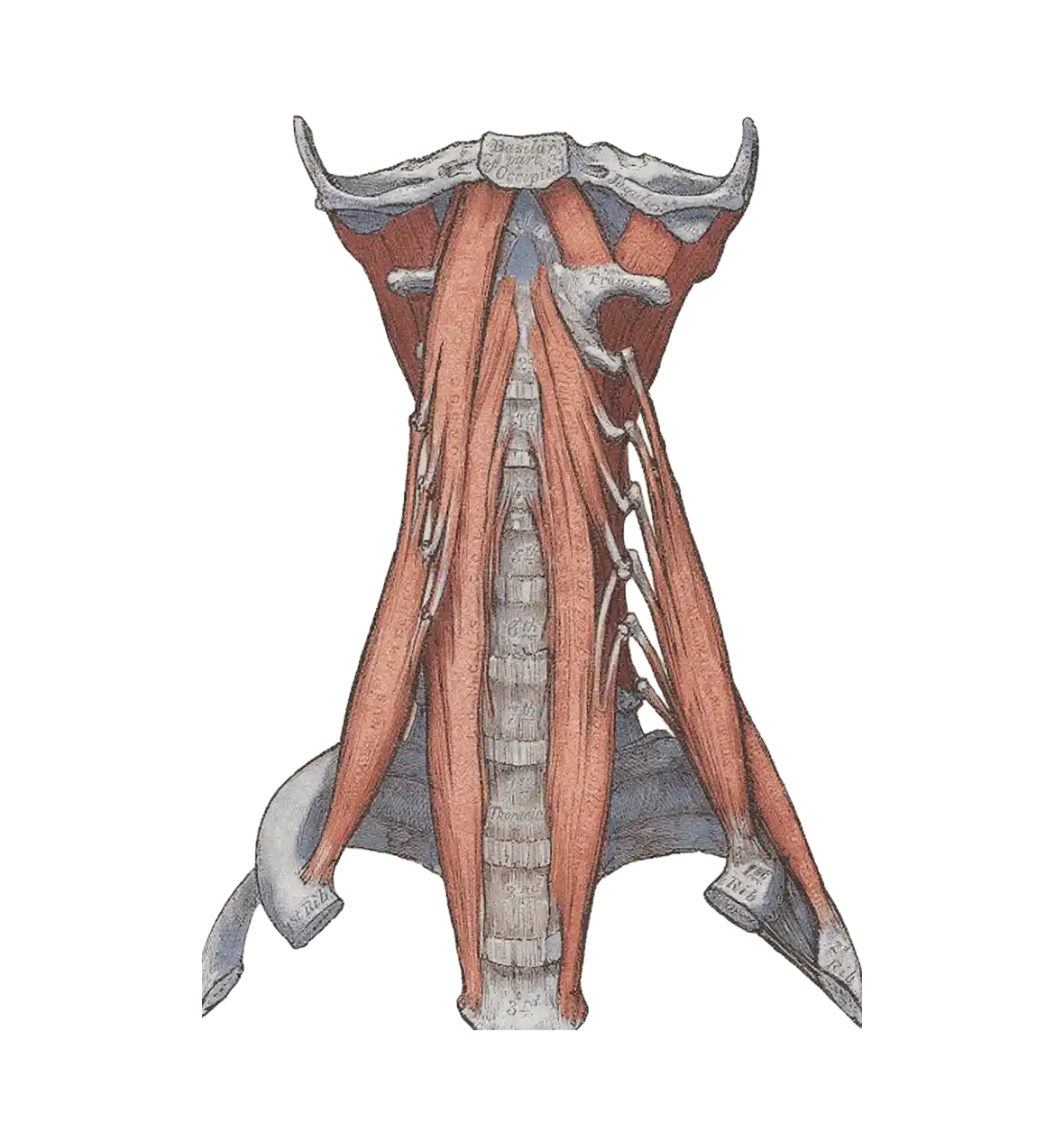
Whiplash can chronically lock the deep stabilizing muscles like longus colli, which require advanced training to release safely and effectively. Anatomy Plate (Gray’s, 1918)
Whole-Body Evaluation
We begin by assessing how your neck, shoulders, and ribcage move together, identifying compensations that have developed since the injury. Establishing an accurate timeline helps determine the safest and most effective starting point for treatment.
Targeted Deep Tissue & Myofascial Work for Immediate Relief
We start by opening the front fascial chain, hip flexors and diaphragm, so the neck isn’t fighting a torso that’s pulled forward. Then the neck itself, in layers: upper traps, levator scapulae, scalenes, SCM, and suboccipitals, then the deep front stabilizers, longus colli and the small muscles around the hyoid bone at the front of the throat. Those deep muscles lock up to guard the injury and take specific training to release. Pressure follows the injury stage: lighter and further from the neck early on, more direct as it settles.
Progressive Plan That Builds on Each Session
As symptoms improve, we integrate the entire kinetic chain—shoulders, spine, hips, and feet—to restore structural balance and retrain efficient movement. This Rolfing-inspired approach ensures each joint plane supports the next for lasting recovery.
Therapists for Whiplash & Post-Whiplash Recovery
Jovaughn
Lead Massage Therapist

Adee
Lead Massage Therapist

David
Owner/Founder

Thom
Lead Massage Therapist

Christopher
Lead Massage Therapist

Kelly
Lead Massage Therapist

Michelle
Lead Massage Therapist

Briana
Lead Massage Therapist

Book now
Book your Session for Whiplash & Post-Whiplash Recovery
What to Expect
A Progressive Plan
Session 1
Calm overactive neck and shoulder muscles, improve circulation, and reduce protective guarding to provide immediate relief.
Sessions 2–4
Expand work through the ribcage, spine, and hips to restore postural balance and reduce strain on the neck.
Sessions 5–8+
Integrate full-body mechanics—linking the feet, knees, hips, ribs, shoulders, neck, and jaw—to create confident, pain-free movement and prevent future flare-ups.
Ready to start feeling better?
See times
Care
Home Care That Helps Between Sessions
We’ll teach you simple at-home techniques—such as controlled neck mobility drills, posture resets, and breathing exercises—to calm the nervous system and keep tissues flexible between sessions.
For example, here’s a helpful video (when in later recovery stages, do not perform immediately after an accident)

Testimonial
What Our Clients Say
Pricing & wellness wallets
Book now. Pay after.
Or load a Wellness Wallet and get extra credit.
Book now · pay after
Book your session
No prepay. A card on file holds your time; you pay after your session.
Senior
Lead
Owner
60 minutes
$175
with a Senior Therapist
90 minutes
$250
with a Senior Therapist
Wellness Wallets
Load credit, get extra
Use it on any 60- or 90-min session at either studio.
Recommended
$800
$920
Covers ~3–5 sessions
+$120
$1,400
$1,650
Covers ~5–10 sessions
+$250
Before your first visit only
$550
$600
~3 sessions with any Senior or Lead therapist
+$50

Frequently Asked Questions
Have more questions? Get in touch
Can massage help whiplash?
Medical massage can help whiplash recovery by releasing the neck and upper-back muscles that lock up to guard the injury, including deep stabilizers like longus colli that general massage rarely reaches. Massage does not repair torn ligaments or fractures, which is why serious crashes need imaging before neck work. Between 15 and 40% of people have whiplash symptoms that linger or keep coming back, and those cases, driven by guarding and compensation, are where massage tends to help most.
How long after whiplash can you get a massage?
It depends on the impact. After a minor collision or fall, if you can move your neck and get yourself to our office, you can usually start within days: we work around the neck first (upper back, ribs, jaw, hips) and add gentle neck work as it settles. After a high-speed crash, a rollover, a fall from height, or any head injury, get your neck imaged first. We won’t do local neck work within six weeks of a serious accident without imaging that shows it’s safe. Go to the ER for numbness, weakness, a severe or worsening headache, or trouble with balance, vision, or hearing.
Do I need a doctor's release for massage after whiplash?
Not after a minor collision. In New York, massage therapists assess whether massage is safe and refer out when needed (NYS Office of the Professions). After a high-speed crash, rollover, fall from height, or head injury within the last six weeks, we need imaging that rules out fracture or instability before working on your neck.
What makes Bodyworks DW’s approach different?
We treat both the local injury and the global compensations that develop afterward—integrating work from the feet to the jaw to rebalance the body. Many of our therapists have advanced training through our Head, Neck & Jaw CEU course, allowing them to perform precise, effective work on structures like the hyoids and longus colli that few massage therapists address.
How many sessions will I need?
Most clients begin noticing improvement within 1–3 sessions, with substantial recovery achieved after 3–6 sessions.
Are there precautions for whiplash massage?
Yes — recent injuries, acute inflammation, fever/illness, or medications affecting tissue integrity require caution. In addition, a recent high velocity impact accident will require that you have been cleared with imaging (see safety note above).
Full list: NYS Massage Therapy Precautions
Resources
Explore our Relief Library

Guides
Deep Tissue After Injury: Safe Timing for Strains, Sprains, and Whiplash
David Weintraub
- Apr 25, 2024


Guides
Doing Physical Therapy? Massage Therapy Can Vastly Improve Results!David Weintraub
- Dec 14, 2020