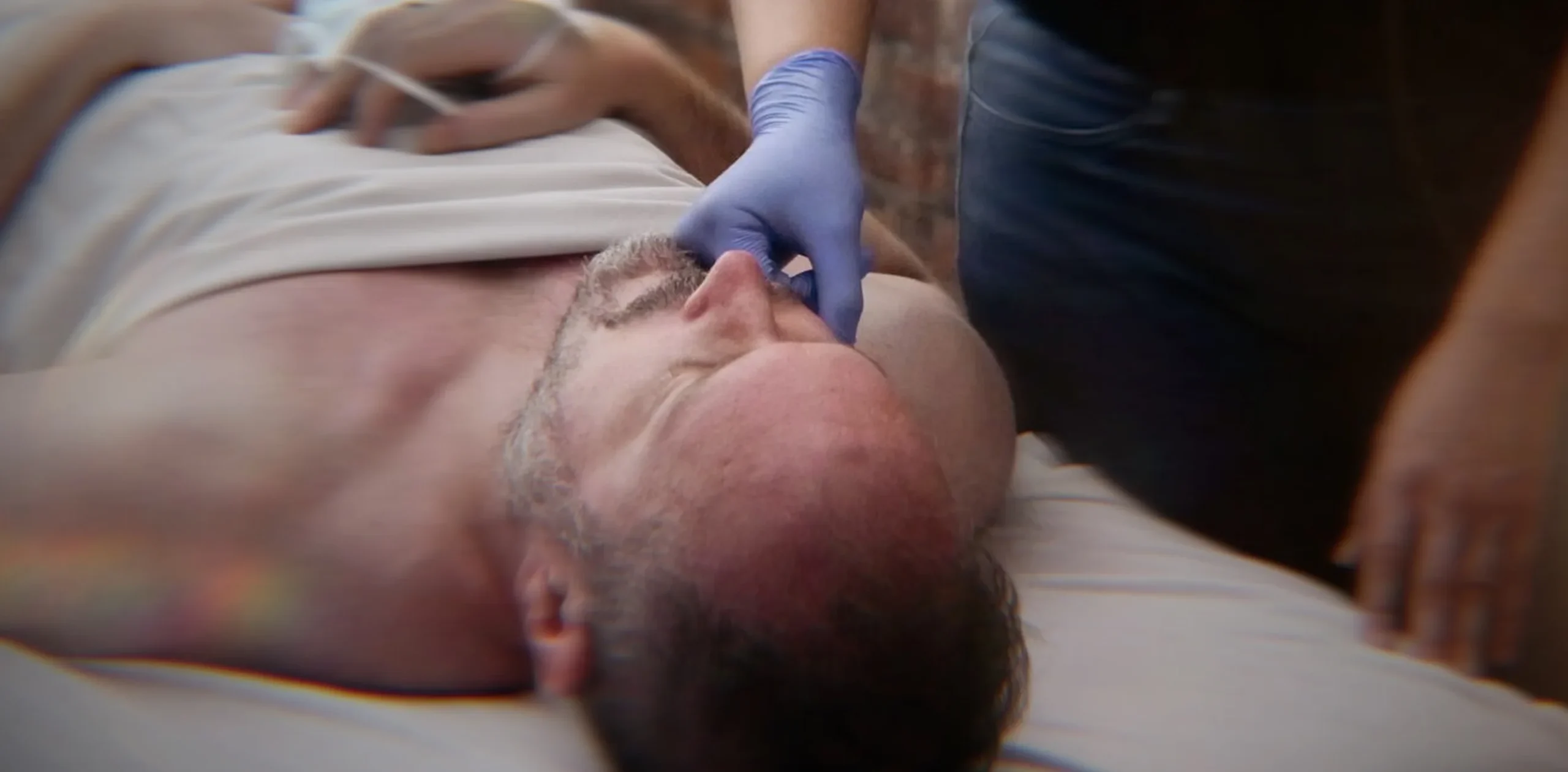
What multiple sclerosis is doing to a working musician
For a long time the Byron’s multiple sclerosis held at a plateau. Recently it began moving again.
His left leg has been getting weaker, and he now wears an AFO, an ankle-foot orthotic, for drop foot. That’s a common feature of MS and other neurological conditions: the muscles at the front of the shin stop holding the foot up, and it flops down, which makes walking genuinely difficult. Newer designs allow more play than the old rigid ones, so he can still engage his calf, which matters for someone crossing a stage.
More alarmingly, a couple of years ago it reached his left arm and hand. Weakness, and a loss of fine motor control. He can still play. Nobody in the audience has noticed yet. But the notes now cost him something they didn’t used to:
“It’s a tremendous amount of energy. I’m wrung out at the end of a show. Actually, I’m wrung out after a couple of songs.”
The set is paced with long intros and a few songs he sits out, which is the only reason it works. A more relentless show and he’d be struggling badly.
Underneath the physical account is the part people don’t see. He spent decades becoming a virtuoso and is now executing parts he wrote years ago at the edge of his capacity. He’s facing a retirement he never emotionally planned for. He’s put on weight, can’t exercise the way he did, doesn’t like looking in mirrors. He describes a psychological spiral that pulls his energy down, which then pulls the physical down with it.
That loop is real and it is not incidental to the case. It’s part of what we’re working on.
And it’s worth saying plainly what kind of musician we’re talking about here. This is a man who, playing Madison Square Garden, hauled his own upright bass through half the crowd to reach a small round stage out in the middle of the floor, because nobody else was going to touch a $10,000 instrument, and then took it home on the subway afterwards. Nobody recognises the bass player. He counts that as one of the better parts of the job.
What massage can and can’t do for multiple sclerosis
The answer runs on a single distinction — structural versus functional. It’s the first thing I establish with any new client, and with a condition like MS it matters more than anywhere else.
A structural problem is a system that’s damaged. MS is structural. It is not something massage therapy can address, and I want to be completely clear about that before anything else: I cannot do anything about the MS itself. I’m not a magician.
A note on cause, since it comes up constantly. What actually causes MS is not fully established. The current understanding is that it involves a genetic predisposition combined with environmental triggers, not one single thing, and not a settled question. What that means practically is that this isn’t something Byron did to himself. It isn’t diet, it isn’t stress, it isn’t a failure of discipline. I have psoriatic arthritis, a different autoimmune condition with the same basic mechanism, the body attacking its own tissue, joints in my case and nerves in his, and I didn’t earn that either. Clinically the cause changes very little about what we do in the room. Emotionally it changes a great deal, and people carry a lot of unnecessary guilt about it.
A functional problem is a software problem. Think of the body as hardware and software. The hardware is bone, tendon, ligament, muscle, blood vessel, organ. The brain is hardware too, but it runs the software, and the software is what tells everything else what to do.
Get your head around the scale of that software for a moment. In the musculoskeletal system alone you have hundreds of thousands of muscle fibres governed by tens of thousands of nerves, all of which have to fire in sequence for Byron to play a bass line. Like any software running that many operations, it has bugs.
Now the cascade, which is the actual point.
MS damages nerves. That’s a second-stage structural problem, and also not mine.
Damaged nerves cause muscles to misfire. Misfiring muscles produce excess tone, pull joints out of position, grind things down, and start taking function away from areas the disease itself hasn’t reached. Misfiring muscles, excess tone, joints pulled out of position — that is the third stage, it is functional, and it is the part massage therapy can work on.
Byron described it himself before I did. His weakness isn’t only weakness. His left hamstring is weak while his quadriceps isn’t, so the leg has no smooth swing. Opposing muscles fight the movement the working muscles are trying to make. When he yawns in the morning, his entire left side seizes with it. If he stands against a wall and lifts his calf, his arm starts to twitch.
“No action of one muscle seems to actually be as separate from the others as I once thought.”
That is a functional description of a structural problem, and it is exactly the territory manual therapy operates in.
So the goal with a progressive condition is not a cure, and I won’t pretend otherwise. It’s this: can I slow the curve, flatten it out, lift him up out of it for a while, and get him through the next fifty years better off than he’d otherwise be. That’s the honest version of what’s on offer.
“So what happens when you release my muscles?”
A client asked me this last year. My answer was: not much.
Or at least nothing permanent happens. You’ll walk out of here in five minutes and those muscles will mostly go straight back to where they were when you came in.
Which sounds like an odd thing to say about a job I’ve done for nearly two decades, so here’s what I actually think the work is.
For those sixty or ninety minutes, your brain gets to experience what it’s like to not have that pattern. And then it goes: that’s better, how do I get more of that? And it starts to recalibrate. That’s neuroplasticity, and it’s the mechanism. Everyone thinks I rub muscles. What I’m actually doing is using muscle and skin as the route to re-teach the brain how to run the software.
Sometimes that’s as literal as turning the computer off and on again.
This is also why the work is structured as a series rather than a one-off. I want to see someone within two weeks of the last session, while the brain is still unsettled. Let it fully reset to its old pattern and you start from scratch each time. Three sessions a week or two apart and then not seeing me for a year does more than six sessions a month apart. For the same reason, sixty minutes more often beats ninety minutes less often, if you’re choosing between them.
What the assessment showed
Before any table work I look at how someone stands, and I say out loud what I’m seeing.
Byron’s stance was wide, feet slightly turned out, which doesn’t happen at the ankle, so it’s coming from the knee or the hip or both. Both arches were substantially collapsed. From the side, a version of the most common posture there is: anterior pelvic tilt, rib cage tipped back at the top, and a head that has to come forward to compensate. His left knee sat noticeably more forward than his right.
And his head was shifted. Not tilted, shifted laterally, well over to the right.
That last one I’d bet money is the bass. When you do something for tens of thousands of hours it writes itself into your posture. I call it occupational patterning, and you can frequently see the instrument in the musician. The counterintuitive part: his symptoms are all on the left, but the right side of his neck was tighter, and releasing the right is what takes strain off the left.
Which is a specific case of something general. Pain isn’t always where the tightness is. Often the tight thing isn’t the problem. It’s the overstretched or weakened thing that’s the problem, because the tight thing is doing all the work, and the overstretched tissue is usually what yells at you.
What changed in ninety minutes
Standing him back up at the end: stance narrower and less turned out, the beginning of an arch on the right, shoulder visibly more open. The left knee, the one that had been markedly bent, was straighter than the right, which matters because that’s the support the whole left side has been missing.
Byron’s own report was the interesting one:
“What I’ve noticed most of all is less tension in my neck.”
We barely touched his neck. No neck sequence at all. That change came entirely from building support underneath it, which is the thesis of how I work, demonstrated better by accident than I could have staged it.
None of this is a fix, and after a couple of weeks back on tour without follow-up it would largely wash out. That’s the argument for a series, not a session.
The homework, and why it’s the one I give almost everyone
Lie on the floor with your legs up on a chair, hips and knees both at about ninety degrees.
The muscle this is aimed at is psoas. Standing or lying flat, psoas is stretched and tight at the same time, and it is unhappy about both. Legs-up-the-wall in yoga shortens it, but you’re still holding your legs up. Feet on a chair shortens it and asks it to do nothing at all.
Give it five to eight minutes, not two. It needs long enough to believe you’re not about to leap up, and you may feel it twitch and then let go. It might not happen the first night, or the first week. When it does, the brain registers that it doesn’t have to hold that all the time, and that’s the part worth having.
No phone. Music and conversation are fine.
What this episode isn’t
It isn’t a claim that massage therapy treats MS. It doesn’t, I said so on camera, and any practitioner telling you otherwise is worth walking away from.
It also isn’t a solo effort. By the end of this session I told Byron he needs a good physiotherapist involved for that left shoulder. The shoulder joint is restricted in a way that needs loading and rehabilitation I don’t provide. That isn’t a hedge. Progressive conditions need a team, and knowing where my part stops is most of what makes it useful.
Where this fits
If you’re living with an autoimmune condition and wondering what manual therapy is realistically for, the structural and functional distinction above is the thing worth taking away. The disease is not workable. A surprising amount of what it sets in motion is.
If that’s your situation, our massage for autoimmune disorders page covers the broader picture across conditions.
We’re doing a series of sessions with Byron before he goes back out on tour, and we’re filming all of them. You’ll see the before-and-after across the whole run, which is a far better test of any of this than one session can be.
If you want to work on something in this territory, we’re in FiDi and Midtown West. Book a 60- or 90-minute visit and tell us what’s going on. And if what you need is someone other than us, we’ll say so.
Frequently asked questions
Can massage therapy help multiple sclerosis?
Not the disease itself. MS damages nerves, and no amount of manual therapy repairs a nerve. What massage can work on is the stage below that: damaged nerves make muscles misfire, misfiring muscles produce excess tone, pull joints out of position, and start taking function away from areas the disease hasn’t reached. That part is workable. The disease is not.
Does massage slow the progression of MS?
No, and anyone claiming otherwise is worth walking away from. What it may do is slow the decline in function that accumulates around the disease — the compensations, the lost range, the postural collapse that follows years of one side working harder than the other. That’s a different claim, and a more honest one.
How often should someone with multiple sclerosis get massage?
More often than most people expect, and the reason is neuroplasticity rather than muscle. The change that lasts happens in the brain, and the brain needs the new pattern repeated before it settles back into the old one. Three sessions a week or two apart does more than six sessions spread a month apart. Sixty minutes more often also beats ninety minutes less often, if you’re choosing between them.
David Weintraub, LMT – Owner, Bodyworks DW Massage Therapy
Resources and support
If you or someone close to you is navigating life with MS, psoriatic arthritis or another autoimmune condition:
Byron’s music
Byron plays bass and sings with The Lumineers and his own band, Lost Leaders, and was a founding member of Ollabelle. His site has the discography, streaming links and tour dates.