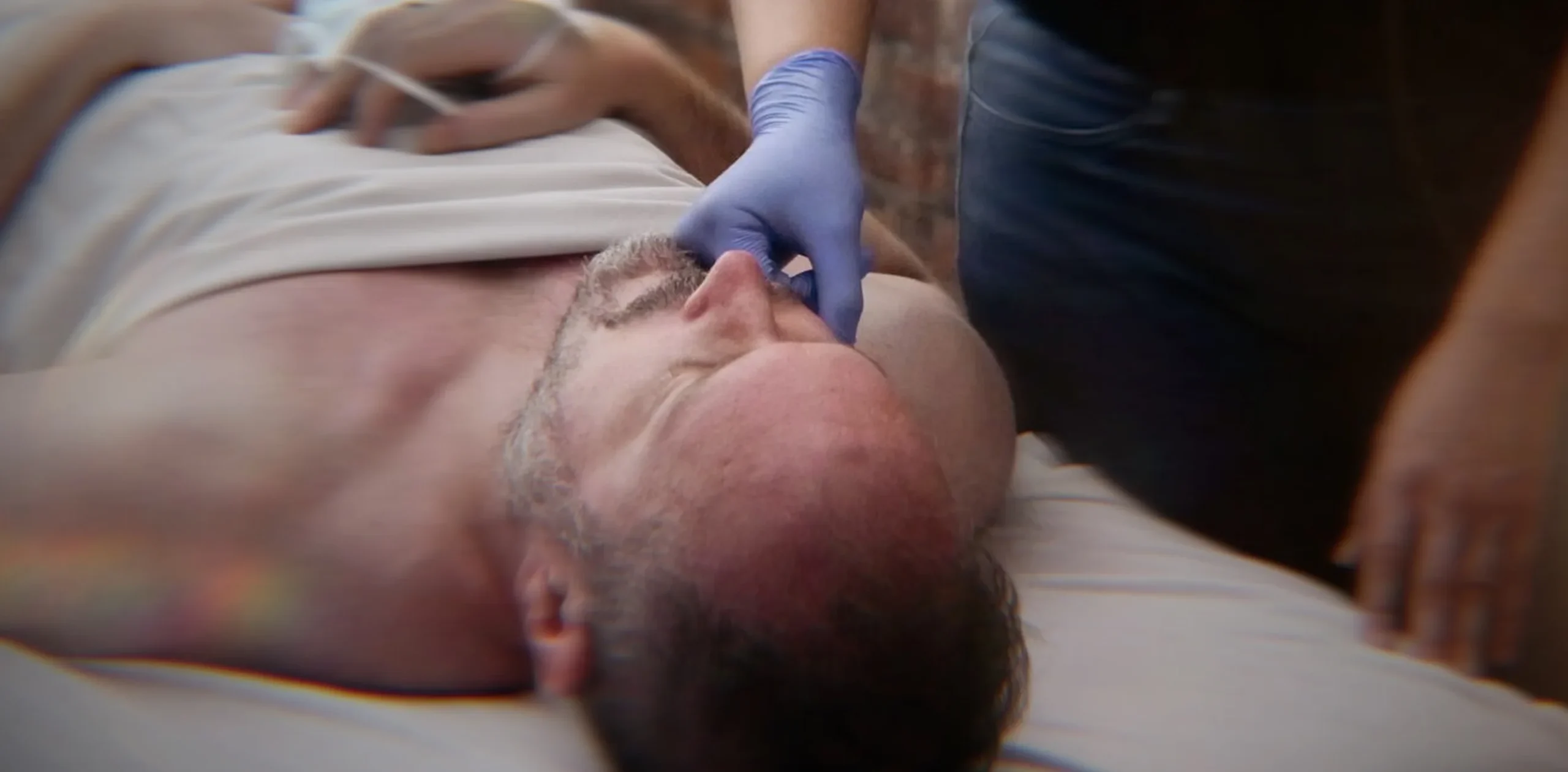
This is one technique lifted out of a longer session walkthrough — we pulled it out because it stands on its own. The full sequence is here if you want the whole thing.
What’s actually happening here
Two muscles are doing most of the work in a tight jaw.
Masseter is the one you can feel at the angle of your jaw when you clench — the obvious suspect, and the one most people already know about.
Temporalis is the fan-shaped muscle at your temple. It’s actually a jaw muscle, but tension here is what most of us associate with a tension headache. It runs from the side of the skull down under the cheekbone to attach to the jaw, and it does a large share of the closing. It’s also the one almost nobody thinks to treat, which is why it tends to still hold tension after everything else has let go.
The release in the video takes about ninety seconds a side. Head turned about 45 degrees, fingers on the temporalis on one side, palm resting on the other, light pressure, then both drawn gently up toward the crown of the head.
It isn’t pressure into the skull. That’s the part people get wrong. You find a depth inside the tissue and then move along that plane — the same principle behind all fascial work. Then a little cross-fibre friction on the temporalis tendon, just above and in front of the ear, and a slow slide down into masseter.
A little pressure goes a very long way in these muscles.
What it feels like
Better than you’d expect, and stranger.
The temporalis draw in particular has an odd, specific effect — clients regularly describe it as feeling like their brain has been switched off. It’s a pleasant sensation rather than a therapeutic-feeling one, which is unusual for jaw work.
The masseter is a different story. If there are active trigger points in there you’ll know about it, and that’s normal — a small amount of gentle friction is enough. Anything that makes you brace is too much.
Can you do this on yourself?
The temple part, yes, and it’s worth knowing.
Fingertips flat on your temples, light pressure, slow draw upward toward the crown. Thirty seconds. No pressing into the skull, no digging. It won’t be as effective as having someone else do it — you can’t fully relax the muscles while holding your own arms up — but it’s genuinely useful at a desk, and it’s the sort of thing worth doing before a headache rather than after.
The masseter and trigger-point work is better done by someone else, and jaw work generally has real contraindications. If you’ve had recent dental surgery, a jaw injury, or you’re being treated for a TMJ disorder, ask before anyone works on it — including you.
Where this fits
This is one technique, and it’s a good one. But jaw tension is rarely only jaw tension.
If your jaw pain comes with headaches, neck pain, or shoulders that never seem to drop, the tension usually starts further down the body and the jaw is where it ends up — which is why we treat headaches and migraines and jaw tension as the same conversation rather than separate ones.
We wrote about the full sequence and why it starts below the jaw — that’s here.
For the broader picture — what TMJ disorder actually is, what causes it and how we treat it — see TMJ and teeth grinding.
Getting this done in New York
We treat jaw and TMJ tension at both studios — FiDi and Midtown West. It’s rarely a standalone service: we’d assess the jaw alongside your neck, shoulders and breathing, because that’s usually where the pattern is coming from.
Book a 60- or 90-minute visit and say you want the jaw looked at.
David Weintraub, LMT – Owner, Bodyworks DW Massage Therapy