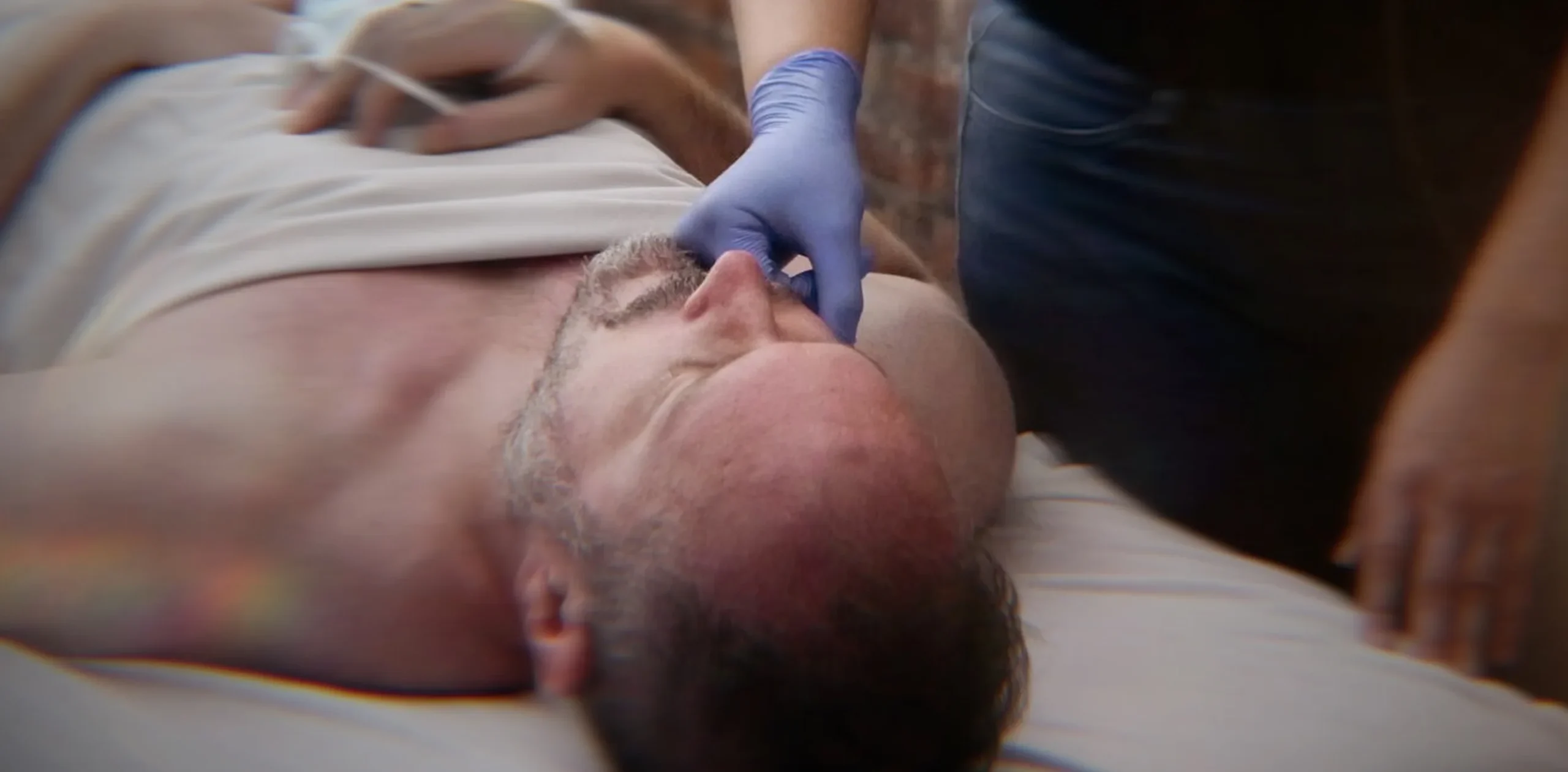
Most people who come to us asking about abdominal adhesions have already been told the problem is somewhere else. Their back. Their hip. Their posture. They have usually tried treating it there, and it has usually helped a little and not lasted.
The abdomen is one of the most under-treated regions in manual therapy, and one of the most common places we find a restriction that explains why something upstream or downstream will not resolve.
It is also surrounded by more bad information than almost any other part of the body — most of it built on a misunderstanding of what scar tissue actually is. So let’s start there, because once you understand the material, everything else about this work makes sense.
What scar tissue actually is
Here is the thing almost nobody gets told: scar tissue is made of the same stuff as healthy fascia. Mostly collagen fibres and water. Chemically, there is nothing exotic about it.
The difference is entirely in the architecture.
Healthy fascia — the tissue that holds your living cells together — has a weave. The collagen fibres are laid down in an organised, fabric-like structure that allows elasticity and movement in particular directions. Which directions depends on the job the tissue has to do:
- Superficial fascia is woven to stretch in essentially all directions.
- A tendon is woven to be strong and elastic in mostly one direction — the line of pull.
- A ligament is woven to be mostly non-elastic on purpose, because its job is to limit movement rather than allow it.
Scar tissue has none of that. When you are injured or cut, the body’s priority is to plug the hole and stop the bleeding, fast. It has no time to weave. The collagen fibres go in like a dropped handful of pick-up sticks — dense, disorganised, oriented in every direction and no direction.
That randomness is what makes scar tissue feel stuck. It is not that the material is harder. It is that the fibres are not arranged to glide.
So what can manual work actually change?
Given all that, here is the honest answer. It is narrower than the internet promises and more interesting than most people expect.
It is not removal. Scar tissue is there for life, barring surgical removal — and surgery introduces scar tissue of its own, so that trade is rarely as clean as it sounds. One of the more common searches that brings people to this page is some version of how to break up abdominal scar tissue. Nobody breaks up scar tissue with their hands.
What changes is elasticity, and it changes in two places. Techniques like pin-and-stretch improve elasticity mostly at the border — the junction where disorganised scar meets woven healthy tissue, and where restriction tends to concentrate. [Deflorin et al., JACM 2020 — the trials behind this are small, with high risk of performance bias in 47% of them.] But over a longer horizon, the scar itself can be loaded in a way that leaves those pick-up sticks slightly better organised: moving a little more like fascia, a little less like a roadblock.
Manual therapy starts that process. Movement is what continues it. An hour of hands-on work is not what remodels tissue over months — repeated stretching, loading and moving through the area, including physical therapy, is what does that. A session that isn’t followed by movement is a session that mostly wears off.
And the largest effect is probably not mechanical at all. When an area is painful or guarded, your brain limits movement there to avoid the sensation — and that guarding outlasts the injury that caused it. What good manual work does best is desensitise the area and restore the feeling of movement, which lowers the guarding, which makes the stretching and the loading and the PT more effective than they could otherwise be. [Keter et al., PLOS ONE, 2025]
That is where the compounding happens. Manual work makes movement available; movement does the remodelling; the remodelling makes more movement available. At some point enough is restored that the area stops registering as a problem at all.
That is a real, worthwhile change. It is just not the one “break up the scar tissue” implies.
Two different things get called “adhesions”
The word covers more ground than most people realise, and the distinction matters for what is likely to help.
True internal adhesions are bands of fibrous tissue that form between abdominal organs, or between organs and the abdominal wall — usually after abdominal surgery, but also after infection, endometriosis, or significant inflammation. When these cause serious symptoms, that is a medical matter and belongs with your physician.
Abdominal wall restriction is what most people are actually describing when they search for this: tension and reduced glide in the layers reachable from the outside — the superficial and deep fascia, the rectus abdominis, the obliques, the transversus abdominis, the diaphragm, and the psoas where it crosses from the lumbar spine into the hip.
I want to be careful not to draw that line harder than it deserves. Internal adhesions are real, and work on surrounding structures — the psoas in particular — may well influence them to some degree. But in our clinical experience they are rarely the actual source of the problem someone walks in with.
There’s a straightforward reason for that, and it comes down to nerves.
The abdominal wall — muscle and the fascia running through and around it — is densely innervated. That is what makes restriction there able to hurt in a way you can point to, and to limit movement in a way you can feel. Internal structures are innervated far more sparsely, and the sensation they produce is vague and hard to localise — the diffuse, can’t-quite-place-it ache rather than the sharp, this-exact-movement pain.
So internal restriction can absolutely limit some movement, and it can affect digestion. It just doesn’t tend to produce the specific, locatable, movement-linked complaint that brings someone through the door. That complaint is usually coming from the wall, the breath and the hip flexors — which is also where the leverage is.
On assessing versus diagnosing
Worth being precise about this, because it gets muddled in both directions.
As licensed massage therapists, we assess. We form a clinical opinion about what is driving your pain, and we treat based on that opinion, using our own knowledge, training and experience. That is squarely within our scope and it is most of the value we offer.
What we do not do is issue a medical diagnosis. Our assessment is not a diagnosis in the formal sense and would not be accepted as one by an insurer or a physician. If your symptoms need a diagnosis, you need a doctor.
Both halves of that matter. Some therapists overclaim; others undersell themselves into uselessness by insisting they have no opinion at all. We have an opinion, we will tell you what it is, and we will be clear about what kind of opinion it is.
What we actually work on
The abdominal wall is a continuous sheet of tissue connecting your ribcage to your pelvis. When part of it stops moving well, the rest of you compensates, and the compensation is usually where you feel it.
In practice that means:
- Mobility of the abdominal wall itself — restoring glide between the fascial layers so the front of the torso moves with you rather than bracing against you.
- The scar and its borders, once fully healed — working the junction between scar and healthy tissue, where the elasticity is available.
- The diaphragm and lower ribs — a guarded abdomen almost always comes with a restricted breath, and the two hold each other in place.
- The psoas and hip flexors — these cross from the lumbar spine through the abdomen into the leg. Abdominal restriction and hip flexor tension are frequently the same problem approached from two directions.
- The connection between upper and lower body — when the front of the torso is restricted, the ribcage and pelvis stop coordinating. That shows up as a back that will not stay long and a body that feels like two halves.
- Separation of the abdominal wall itself — where the rectus abdominis has separated, as in diastasis recti, the wall’s ability to transmit load changes, and that shapes what’s appropriate to do and when.
Signs your abdominal wall may be part of the picture
These are the things that make me want to assess the abdomen, even when the complaint is somewhere else:
- My low back pain improves with treatment and comes straight back
- I can’t take a full breath
- Standing up straight takes effort, and I collapse forward as soon as I stop thinking about it
- My ribs and hips feel like they don’t quite line up
- There’s a pulling or tethered feeling in my abdomen when I reach overhead or extend backwards
- My hip flexors feel permanently tight no matter how much I stretch them
- I have an abdominal scar that feels stuck, numb, or hypersensitive
- Something about my midsection feels braced, and I can’t consciously release it
None of these is conclusive on its own. Several together is a good reason to have the area looked at.
What a session looks like
Less of an event than people tend to expect.
You stay draped throughout, the same as anywhere else on the body. Therapists differ in how they approach it — some ease in with light, still contact on the abdomen while working somewhere else entirely, some prefer to re-drape and talk each step through first. Both are normal. Say what you’d prefer and you’ll get it.
The work itself is not deep-pressure work. The abdomen doesn’t respond to force, it guards against it, so effective work here is slow and light and checks in as it goes.
Slow and light can still feel intense, and it’s worth saying so — this is a guarded area for most people, and sensation here often lands bigger than the pressure being used would suggest. That’s normal and it isn’t a problem. The standard we work to is an intensity you can settle into rather than brace against. If you’re bracing, it’s too much, and we back off.
We’ll ask about your surgical and medical history before we start, because it changes what’s appropriate — but that’s intake, not ceremony.
Most people leave with something to do between sessions, and given how much of the benefit comes from movement rather than from the hour on the table, that part matters more here than it does almost anywhere else. What it is varies: some people need restorative positions and breathing, others need active movement and a reason to get out of a chair more often. Prescribing the same homework to both is how this work stops helping.
When abdominal work isn’t appropriate
This is not a complete list and it is not a substitute for your doctor’s judgment. We will not work the abdomen if you are recovering from recent abdominal surgery and have not been cleared, if you have an active infection or fever, if you have a known or suspected hernia in the area, or if you are pregnant and we are not working within prenatal scope.
Some abdominal symptoms need a doctor the same day, not a massage therapist. Severe or rapidly worsening abdominal pain, vomiting, inability to pass gas or stool, fever with abdominal pain, or a visibly distended abdomen can indicate a bowel obstruction, which is a medical emergency. Adhesions are one of its causes. If that is what you are experiencing, seek medical care rather than booking a session.
We would rather turn a session down and be right than take one and be wrong.
Where this fits
It is usually the missing piece in a plan that also involves the low back, the hips, the ribcage or the breath — which is why we assess it as part of medical massage rather than as a standalone service.
If the pattern above sounds like yours, book a 60- or 90-minute visit and say you want the abdomen assessed. We’ll look at it in the context of everything else going on.
David Weintraub, LMT – Owner, Bodyworks DW Massage Therapy
Updated on September 2, 2026