What the psoas is, and why sitting is hard on it
Your psoas runs from the front of your lumbar spine, through the pelvis, and attaches to the inside of your femur. It is one of the few muscles connecting your upper body to your legs directly, which is why it turns up in so many low back and hip complaints that seem to have no obvious cause.
Here is the part that catches people out. When you are standing or lying flat, the psoas is stretched and tight at the same time, and it is unhappy about both. It is being asked to hold length it does not want to hold. Sitting all day is the other end of the problem: shortened for hours, then abruptly asked to lengthen the moment you stand up.
Which is why the answer is not more stretching. A muscle in that state does not need to be pulled on. It needs to be convinced it can stop working.
The release: legs up on a chair
This is the first piece of homework we give almost every client, and it is deliberately unimpressive.
Lie on the floor with your lower legs resting on a chair, hips and knees both at roughly ninety degrees. That is the whole thing.
It is specifically not legs-up-the-wall, the yoga version. In that position you are still using your core to stop your legs falling, which means the psoas is still working. Feet on a chair shortens it and asks nothing of it at all.
Give it five to eight minutes, not two. It takes that long for the nervous system to accept that you are not about to leap up and need it again. You may feel it twitch and then let go. It may not happen the first night, or the first week. When it does, your brain registers that it does not have to hold that all the time, and that is the part worth having.
No phone. Music and conversation are fine.
The adductor variation
Once the first position feels settled, move your feet a little closer to the edge of the chair and let your knees fall apart, using the arms of the chair so they do not flop all the way open.
This gives the adductors — the inner thigh muscles, also tight from sitting — a very gentle opening. And gentle is the point.
Go into a deep stretch and the muscle will often respond by tightening against you. That is a protective reflex, not stubbornness. So instead you find a half-open position, stay there a few minutes, and let it get used to the idea. We spend a lot of our day tightening muscles and then expect them to open on demand, and most of them will not cooperate with that.
The passive figure-four
Nearly everyone knows the standard figure-four stretch. It is not a bad stretch, but it asks you to activate a set of muscles in order to perform it. This version does not.
Cross one ankle over the opposite knee. Then think about the bottom of the top foot rotating toward the floor, and let everything from the pelvis down turn that way — while your rib cage and upper body stay flat.
The goal is that your ribs stay on the floor. Not everyone can do that at first. If your ribs lift, put a pillow under the leg so the position is easier to hold, and stretch the opposite arm away to help keep the rib cage down.
Done this way it is a piriformis and deep hip rotator stretch, plus a gentle QL stretch and a mild lumbar twist — without the intensity that makes a low back guard against it.
Because it is passive you can simply stay there for thirty to sixty seconds. Both sides, always.
Two cheap tools worth owning
Neither of these is expensive, and we keep both at every studio.
The peanut-shaped foam roller
Two foam lobes joined in the middle, with a scoop between them. Around fifteen dollars.
For the sitz bones. Put it on a chair and sit directly on it, on your sitz bones — the ischial tuberosities, the two bones you feel when you sit on a hard surface. The width of this shape is right for that, where most double-ball rollers are too narrow. Sitting on it reaches the attachments of the deep six rotators, including piriformis, and some of the glutes. Once that feels manageable, make small circles on it to find the different attachments. A little goes a long way. Once a day when you get home makes a noticeable difference.
For the muscles alongside your spine. Lie on the floor with it just under your lowest ribs, lift into a small bridge, and roll gently up and down over the erector spinae — the ropy columns either side of the spine.
The scoop in the middle is the whole reason to use this rather than a regular foam roller: your vertebrae pass through the gap instead of being pressed on. Once you have some movement, add small spinal rotations and work up a vertebra at a time. You may get some pops. Fine if they arrive on their own. Don’t chase them.
Half balls
Half a firm ball with a flat base. They don’t roll away, and being shorter, they let you reach a muscle without lifting yourself high off the floor or loading it as heavily.
For gluteus medius and minimus — the muscles on the side of your hip that get tight from sitting.
Place one on the floor and lower your hip onto it. You are aiming for the space between the greater trochanter — the large bony point on the side of your hip — and the pelvic crest, the top ridge of your pelvis. Find a spot in that triangle that feels rough and rest on it.
The pressure is adjustable, in this order:
- Propped up on your forearm, weight partly off the ball — least
- Lying all the way down — more
- Adding internal and external rotation of that leg — most, and this is what pins and stretches the muscle across the ball
For most people the first position is plenty. It is unpleasant while you are doing it and noticeably better once you stand up. Both sides.
When self-care is not the answer
All of the above is genuinely useful and none of it replaces having someone assess you.
Psoas is deep, it sits behind your abdominal contents, and it is not a muscle you can reach on yourself with any precision. What you can do at home is give it the conditions to relax. What you cannot do is find out whether it is actually the problem, or whether it is compensating for something else — a hip that does not rotate, an old injury on one side, a foot position that has changed how you stand.
As for when to get something looked at medically first — worth being clear about this, because a lot of self-care advice online sends people to a doctor for things we work on every week.
Sciatica, mild neuropathy, an ache that wakes you at night: we treat all of those routinely. Having the symptom is not the question. The pattern is what matters — how severe it is, how fast it arrived, and whether it is on one side or both.
- Severity. Discomfort you are working around is a different thing from pain that is stopping you moving well enough to do basic things like stand, walk, lie down, etc. If it is genuinely disabling, get it assessed before anyone puts hands on it.
- Speed of onset. Something that has crept up over months behaves very differently from something that arrived over a few days. Fast and severe is the one to take seriously.
- One side or both. Most musculoskeletal patterns are lopsided — one hip, one leg, one side of the back. Symptoms arriving on both sides at once, particularly numbness or weakness that seems to be climbing, is a different category and wants a medical opinion rather than a massage.
Two things are not wait-and-see at any severity: a change in bladder or bowel control, or numbness through the groin and inner thighs. Those are an emergency room conversation today, regardless of how everything else feels.
Beyond that — the achy hip, the low back that has grumbled since you started working from the sofa, the leg that tingles after too long in a chair — is ordinary, extremely common, and usually very workable.
What a session actually involves
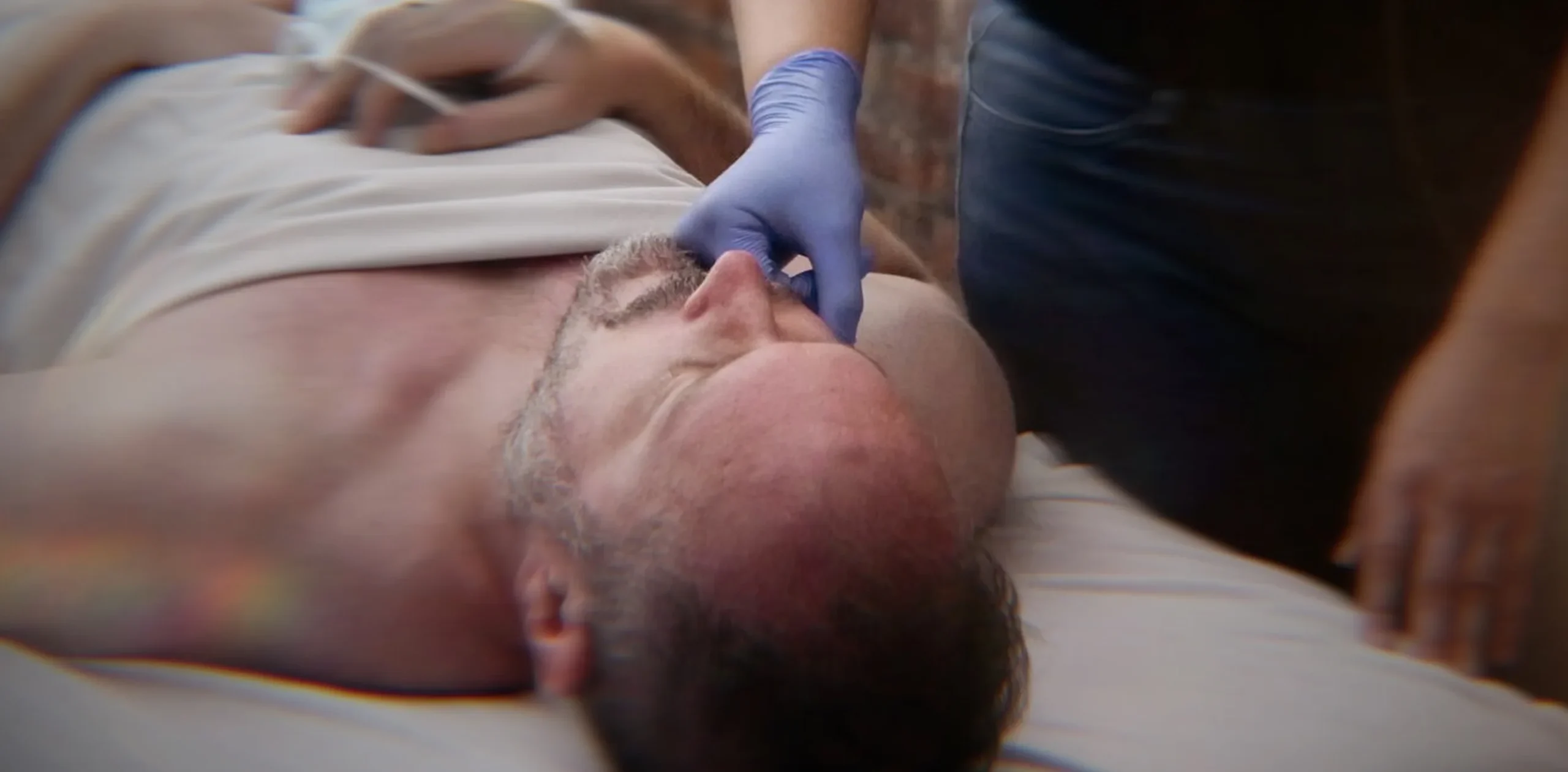
When we work on the psoas, it is slow and it is specific, and it is rarely the whole session. We are usually working the hip rotators, the adductors, the lower back and the ribs in the same visit, because the psoas is generally responding to what those are doing rather than acting alone.
Most clients are surprised by how little pressure is involved despite the intensity. Lots of pressure is not what makes this work. Finding the right layer of depth in the tissues and giving the nervous system time to let go is what makes it work, and that is difficult to rush.
This is also why we tend to see people for a short series rather than once. The homework above is what holds the change between visits.
Where this fits
We are in FiDi and Midtown West. If your low back or hips have been nagging at you and stretching has not touched it, book a 60- or 90-minute visit and tell us where it lives.
David Weintraub, LMT – Owner, Bodyworks DW Massage Therapy