What Trigeminal Neuralgia Actually Is
The trigeminal nerve is one of your twelve cranial nerves — nerves that run directly from the brain rather than out through the spinal cord. It carries sensation from your face, and it drives the muscles you chew with.
Trigeminal neuralgia is sudden, severe, usually one-sided facial pain along the path of that nerve. People describe it as stabbing, electrical, or burning. It very often presents first as tooth pain, which is why a great many people start at the dentist. Kimberly did.
Clinically it is sorted into three categories:
- Classical — a blood vessel is compressing the nerve at its root, with visible changes to the nerve on imaging.
- Secondary — an underlying disease such as multiple sclerosis or a tumor explains the neuralgia.
- Idiopathic — neither of the above is confirmed.
First-line medical treatment is carbamazepine or oxcarbazepine. When medication fails or becomes intolerable, microvascular decompression is the first-line surgical option. The condition also carries a documented increase in anxiety, depression, and disrupted sleep — a reality that gets treated as a side note far too often.
None of that is massage therapy’s territory. Diagnosis belongs to a neurologist. Imaging belongs to a neurologist. Medication and surgery belong to a neurologist and a neurosurgeon. If you have facial pain and no diagnosis, that is where to start, and nothing below changes it.
What Massage Therapy Can (and Can’t) Do for Trigeminal Neuralgia
Massage therapy does not treat the cause of trigeminal neuralgia. It cannot repair a compressed nerve root, resolve demyelination, or touch a tumor. What it can sometimes treat is the tissue around the nerve — and only when that tissue is part of the problem. Anyone who tells you otherwise is selling something.
When Massage Can Affect the Nerve Pain Itself
Massage therapy can sometimes reduce trigeminal nerve pain itself when tension in tissue along the nerve’s path outside the skull is adding to the irritation, even though it cannot touch the cause inside the skull.
This is how we approach every compression problem we treat. With carpal tunnel, working only on the wrist rarely holds, because the nerve is usually being irritated at several points on its way down the arm — the neck, the thoracic outlet, the elbow — and each one adds to the load. It’s known as the double crush effect: a nerve compressed at one point becomes more vulnerable at others. In practice I think of it as closer to seven or ten. Relieve enough of those points and the nerve can tolerate what’s left.
The trigeminal nerve works the same way. After it exits the skull, its branches travel through a region of fascia connected to structures I can physically reach — in particular the medial and lateral pterygoids, small chewing muscles behind the upper back molars whose fascia runs up toward the sphenoid bone, the sinus cavities, and the tear duct region. Those muscles sit at the top of the same chain that runs down through the neck, chest, and arm — the other end of the chain we work for carpal tunnel. That is why the session described below spends most of its time nowhere near the face.
It is also the honest explanation for why results vary so much. If tension in that region is one of the points loading the nerve, releasing it can change the symptoms, sometimes dramatically. If it isn’t, there is nothing for the work to relieve. In idiopathic cases there is a further possibility: some may be myofascial pain that mimics trigeminal neuralgia, which is muscle pain in the first place.
What the work cannot do is reach the compression at the nerve root. A blood vessel pressing on the root inside the skull, a tumor, or demyelination from MS is beyond anyone’s hands, and if one of those is the whole story, manual therapy will not change the neuralgia. That is why I take these cases rather than declining them, why I give odds rather than promises, and why “massage can’t help trigeminal neuralgia” is too flat an answer.
The odds I give before we start
So the honest framing is a probability, not a promise. When Kimberly first contacted me, I told her I put her odds at 30 to 40 percent. Across roughly two dozen cases of trigeminal nerve compression in my career, my results have been less than a coin toss. That is not a comment on the work. In the cases I could not help, the cause was simply beyond the reach of anything hands can do. I said that to her before she booked.
I also gave her a stopping rule, and I give everyone the same one: you should know within about three sessions whether this is worth continuing. It does not have to be a big change, and it does not have to last. Relief that shows up and then fades still counts as a signal, because it tells me the tissue is responding at all. What does not count is nothing. If there is no noticeable change by the third session, I will tell you to stop. I am not going to sell you a course of care for a condition I may not be able to affect.
In practice the pressure usually runs the other way. When someone has had nothing work for years, a 5 or 10 percent improvement feels enormous, and I will be the one saying I want to try something different while they tell me not to touch a thing. I understand the instinct. But a small change usually means we found the right direction, not the right amount — and the way to get more is to adjust, not to repeat.
The safety part most people skip
This matters more here than in almost any other condition we treat. Most people with trigeminal neuralgia have trigger zones — small hypersensitive areas that set off an attack when touched. They are reported in a wide majority of patients, and the nasal wing and upper lip are the most common sites. Light touch to the face is the single most common trigger, reported by around four in five patients. Talking, chewing, and brushing teeth all provoke attacks in a substantial share.
Which means the instinct a general massage therapist brings to working on a face — light, gliding, gentle strokes — is the exact stimulus most likely to cause an attack.
Interestingly, slow sustained pressure appears substantially less likely to provoke an attack than light moving touch. That is part of why this work can be tolerable when a gentle facial is not. It is not a loophole, and it is not an excuse to press on someone’s face and hope. It is a reason that specific training matters here, and it is why a lot of good therapists are right to decline.
Here is how that played out with Kimberly, and the decision was hers. She asked me not to touch the outside of her face at all. That was easy to agree to — there is no route from the skin of the face to decompressing a cranial nerve, so declining it costs nothing therapeutically. What it left was the inner-mouth work, which I could give her a reason for. I told her it might set off an attack. She chose it anyway, because it was the one thing with a mechanism attached.
So in session one I worked temporalis externally — the side of the skull, away from where trigger zones concentrate — and left masseter alone, because masseter sits over the cheek in exactly the territory where they do. The pterygoids I reached from inside the mouth, where the facial skin never gets touched at all. I did not do any external work on her face until session three, once her symptoms had already settled.
I want to be straight that in terms of triggering an attack, this was the lower-probability route, not a risk-free one. Trigger zones occur inside the mouth as well as on the face. It was a considered risk, taken with the information in front of us, that she chose to take.
Why So Many Practitioners Said No
Kimberly’s experience of being turned away was not unusual, and it was not unreasonable. In her words: “Some people were just kind of terrified of nerve pain.”
I want to be fair to those therapists. Declining work you are not trained for is the correct call. A therapist who says “I don’t feel comfortable with this” is behaving ethically. The problem Kimberly ran into was not that people declined — it was that nobody could tell her who would take it on, and she was left doing that search herself while in severe pain.
Training in inner-mouth work is uncommon to begin with. Most of our team is trained in it, because it is genuinely useful for TMJ, jaw tension, headaches, and migraines. A smaller number have worked directly on trigeminal nerve pain, and that experience tends to come from outside a massage-school curriculum. I came to it because I have spent a career accepting cases other people send away — and because when someone hands me an MRI with something on it I have never seen, my first move is to check whether I am even permitted to work on them.
That is a real skill, and one worth developing: knowing what is contraindicated, and being honest when the answer is no. It is also an argument for continuing education. Over nearly two decades in practice, the answer to whether a given thing is contraindicated has changed for several conditions.
Kimberly’s Road to a Diagnosis
Kimberly is a licensed creative arts therapist and a board-certified music therapist. She works in a pediatric hospital, and she spends twenty-five to thirty hours a week playing guitar — often leaning over a hospital bed, craning around a large-bodied acoustic, playing for sick and dying children.
Her symptoms began in April 2024 as stabbing pain in her upper jaw. She assumed a cavity. Full dental imaging found nothing.
She went to her physical therapist, who told her something was wrong but that he did not think it was a pinched nerve and could not say what it was. Meanwhile she was sleeping in a reclining chair at a family member’s hospital bedside, and her posture — already compromised by her job — got worse.
Then a traumatic loss that summer. And as she put it, “as the terrible patient that I am, my first thought was: this is grief.” She spent three or four months assuming her body was producing pain out of sorrow.
It ended on a sidewalk. A cold gust of wind hit her face and she collapsed in agonizing pain, crying, unable to stand.
Grief and stress are real, and they genuinely influence pain. But grief does not put you on the pavement. If your pain is doing that, it is not in your head, and you need imaging and a neurologist — not more patience with yourself.
She got in with a neurologist within days. He called it textbook trigeminal neuralgia on sight and confirmed it by MRI: a compression of the nerve. He also made a point of praising her dentist for not operating — telling her that by the time many patients reach neurology, they have had multiple unnecessary root canals from dentists chasing the pain.
Then her PT helped, but only for a day or two at a time. Acupuncture helped some things, but not the stabbing and burning. Two massage therapists: one session with the first, and in her words, “nope, this is not okay.” Four or five with the second — again, relief for a day or two, nothing lasting.
Then a badly timed, brilliantly targeted ad of ours was served to her at 2 a.m.
What We Actually Did
The theory we agreed on was specific: her guitar posture, her neck, her jaw, and the fascial line connecting all of them might be contributing tension to the region the trigeminal nerve passes through. If so, releasing that chain might change her symptoms. If not, it wouldn’t.
The first session ran roughly 55 to 60 minutes and almost all of that was not work on her face or jaw:
- Legs and hip flexors. Psoas and iliacus, and the lateral line of the leg. Her ankles roll inward, one more than the other, and that travels all the way up. For clients with headaches, jaw pain, and neck pain I will sometimes spend an entire hour from the knee down later in a series and watch the shoulders drop without ever touching them.
- Rib cage and breathing. Hand under the scapula, forearm on the lower ribs, working with her breath to let the rib cage settle back where it belongs.
- Chest and arm. Pec major and pec minor, down through the arm to the fretting hand. She plays medium-gauge bronze strings on a large acoustic — that takes real tension to fret, and it mangles a shoulder over years. It’s one of the reasons I always preferred playing electric guitar over acoustic honestly. (Okay, it was also distortion pedals….)
- Neck and head. Scalenes, levator scapulae, splenius cervicis, SCM, suboccipitals, and temporalis. No masseter, and nothing on the outside of her face — see above.
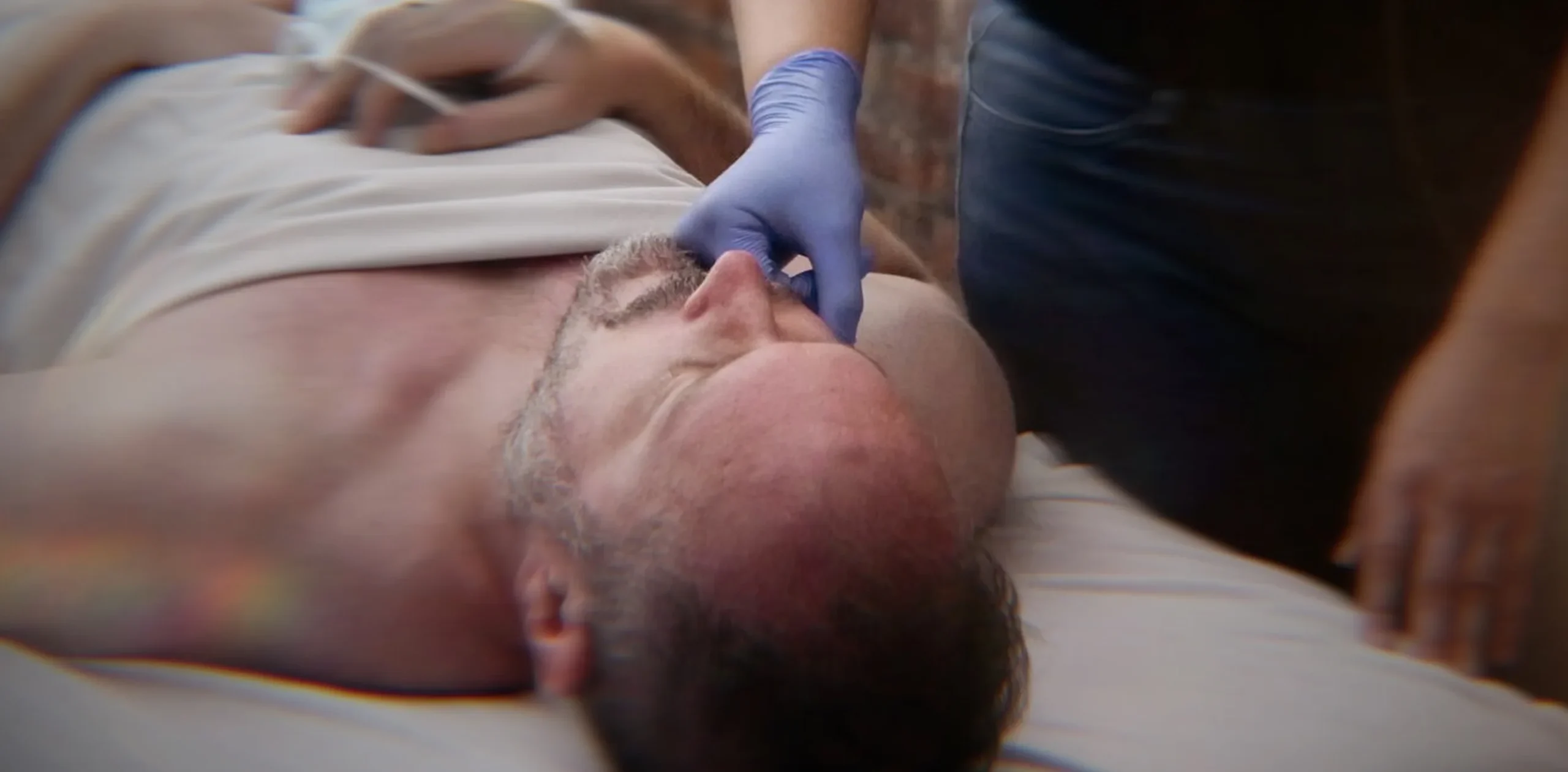
- Inner-mouth work, last. The lateral and medial pterygoids, four points total, held while she mobilized her jaw side to side and forward.
That last part takes about five to eight minutes at most at the very end of a session. It is not an hour of someone’s fingers in your mouth — and the sequence matters. The inner-mouth work is the capstone. By the time we get there, the entire fascial line feeding up into that space has already been opened, so when those small muscles release they have somewhere to release from… and somewhere to release to.
On intensity, honestly: clients rate the medial pterygoid work around a seven or eight out of ten. That is not a measure of how hard I am pressing. These are tiny muscles and it takes very little pressure to feel terrible. Probably about the pressure it takes to push an elevator button. If you use real force in there, your client will leave and never return.
We discuss all of it before gloves go on. Nobody gets a finger in their mouth as a surprise.
What Happened
Kimberly was almost completely symptom-free the next day, and entirely symptom-free two days later. No tingling, no numbness, no jaw locking.
She noticed it most at work, and cried in a supply closet — not from pain, but because it was the first time in over a year that her face had felt like her face.
I want to be precise about my own expectations here: I would not have bet a dollar on that outcome. If we won the coin toss at all, I expected 20 to 30 percent improvement. Not 80. Not 100. It genuinely surprised me.
Symptoms did return somewhat in the following weeks. That is normal and it is not failure. Across five or six sessions she has settled into being asymptomatic most of the time, with occasional tingling in the corner of her nose that sometimes makes her sneeze. Her framing: “on the scale of I can totally deal with this, to I’m stuck in bed and can’t do my job — I’ll take sneezing and a little bit of tingly.”
What This Case Does Not Mean
It does not mean massage therapy is a treatment for trigeminal neuralgia. It means that in a few cases I’ve worked on, where tension in reachable tissue appears to have been part of what was irritating the nerve, releasing that tissue has changed the picture dramatically.
I have had roughly two dozen of these cases. Most did not go like this. Some have had real improvement over six to eight sessions, enough to bring their symptoms into mostly manageable territory.
Very few things in medicine are “cured” in the sense most people mean — gone forever. Nerve pain, muscle tears, a labral tear in a shoulder: these are managed. The realistic goal is not erasure. It is getting you far enough toward the manageable end that you have agency — you know your triggers, you know what a flare costs you, and you choose accordingly. As I put it to her — if you go out in the wind, you might want to wear goggles.
And my goal has always been that you stop needing the work. So if we get your symptoms down to manageable, the next question is how far apart we can space your sessions so that they don’t come back — six weeks, twelve weeks, whatever holds. But I really don’t want to see you every week forever, even if you think that’s what helps you. If we get stuck in that kind of pattern I’m going to refer you out to try other things.
If You Have Trigeminal Neuralgia
Kimberly asked to pass one thing on, and it is hers, not mine: “Don’t send yourself down the WebMD Reddit Google dumpster fire rabbit hole.” What she found there was people for whom nothing had worked, and the nickname this condition carries because of how severe the pain can get. What she could not find was a single story of someone doing well. That absence is most of why she agreed to sit down on camera.
So, plainly: this condition is associated with real rates of anxiety, depression, and disrupted sleep, and that is a medical part of it rather than a character failing.
I know what nerve pain does to a person. In 2016 I had a cervical disc herniation that lit up my left arm at a constant six out of ten, and if I sneezed it went to a nine and a half for fifteen minutes at a stretch. What got me through it was knowing it was treatable — that a combination of PT and myofascial release would eventually work. Without that knowledge I think I would have taken anything to make it stop. It still took two solid months to get it manageable and four to truly put it behind me.
So if you are struggling with that side of it, it is worth raising with your care team directly. In the US, the 988 Suicide & Crisis Lifeline is available by call or text at any hour.
On finding hands-on help, three things worth knowing:
- Get the diagnosis first. Imaging and a neurologist. Manual therapy is not a substitute for finding out what is compressing the nerve.
- Ask directly whether they have worked with trigeminal nerve pain. A therapist who says no is doing you a favor. A therapist who is unfazed but cannot explain the anatomy to you is the one to avoid. If you can’t find someone with direct experience, look for a therapist who has worked with other nerve pain issues and with TMJ — and who won’t claim confidence they haven’t earned, but is willing to read up on what might and might not help, and willing to try. That is how I handled my first client who walked in with it.
- Insist on odds, not promises. Anyone who guarantees you relief from trigeminal neuralgia is wrong. Ask what would tell them it isn’t working, and how quickly they would say so.
In Kimberly’s words, on why she tried anyway: “The worst thing that happens is that you don’t get relief.”
If you have been turned away elsewhere and want an honest read on whether this work could help you, we are in the Financial District and Midtown West. Tell us what your imaging says, and we will tell you what we think the odds are — including when the answer is that we can’t help.
Frequently Asked Questions
How will I know if massage is helping my trigeminal neuralgia?
You should know within about three sessions. It doesn’t have to be a big change and it doesn’t have to last — relief that shows up and then fades still counts, because it tells me the tissue is responding at all. What doesn’t count is nothing. If three sessions produce nothing, I’d rather tell you that than keep booking you.
Is it safe to work on the face with trigeminal neuralgia?
It depends entirely on where the trigger zones are and how the work is done. Light, moving touch is far more provocative than slow sustained pressure — which is the opposite of what most people assume. Trigger zones concentrate around the nasal wing and upper lip, so those areas warrant real caution. The decision about what gets touched belongs to the client, not the therapist.
Can massage reduce trigeminal nerve pain itself, or only the surrounding muscle tension?
Massage can sometimes reduce trigeminal nerve pain itself, not only the surrounding muscle tension. It cannot reach the cause inside the skull — a blood vessel compressing the nerve root, a tumor, or an MS lesion. But a nerve irritated at one point is more vulnerable at others along its path, and the trigeminal nerve’s branches pass through the pterygoid region, which can be worked from inside the mouth. When tension there is adding to the irritation, releasing it can reduce the nerve pain even when imaging shows compression at the root. It can’t be predicted in advance and shouldn’t be promised, but you should know within about three sessions.
David Weintraub, LMT – Owner, Bodyworks DW Massage Therapy
Related reading: Massage for TMJ & Teeth Grinding · Massage for Headaches & Migraines · Jaw Pain or Tension? Here’s How We Combat It · Massage for Tech-Neck & Head Forward Posture
Sources: Pathogenesis, Diagnosis, and Management of Trigeminal Neuralgia: A Narrative Review, Journal of Clinical Medicine (2025) · Trigger zones in trigeminal neuralgia: clinical features, pathophysiological mechanisms, and therapeutic strategies, Frontiers in Neurology (2026) · The double crush in nerve entrapment syndromes, Upton & McComas, The Lancet (1973) · A case of facial myofascial pain syndrome presenting as trigeminal neuralgia, Yoon et al., Oral Surgery, Oral Medicine, Oral Pathology, Oral Radiology (2009)