
In this article
- A shrinking profession, and when it started
- A short history, because it explains the money
- What the work actually pays in NYC
- The private practice math nobody runs
- Four types of therapist who go independent
- The franchise math, and what a job ad won’t tell you
- About the robots
- Will we ever take insurance?
- Burnout: the real numbers
- Four things school doesn’t prepare you for
- The case for doing it anyway
- If you’re weighing this up
The thing nobody’s saying out loud
There are fewer of us than there used to be, and it didn’t start with the pandemic.
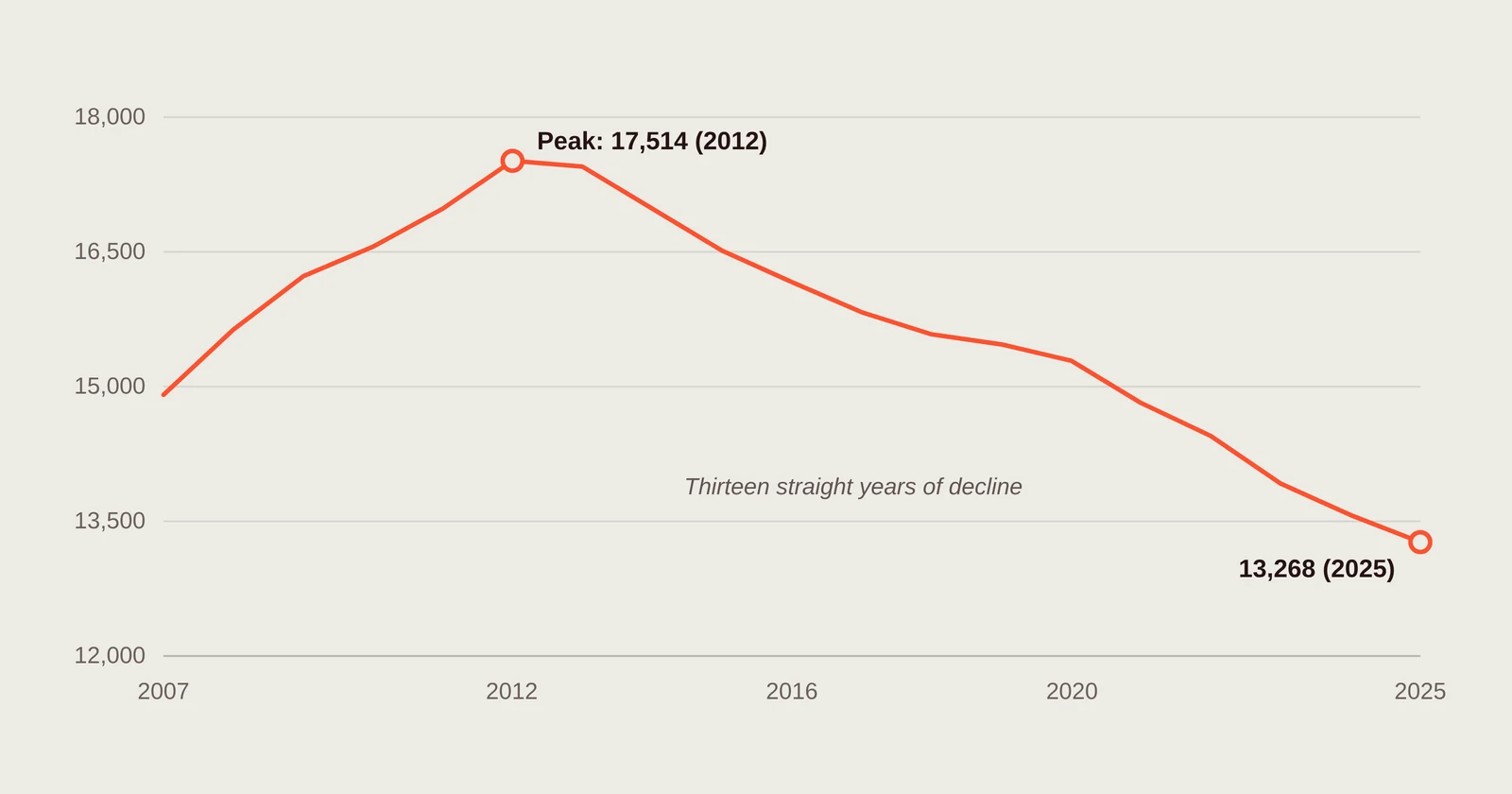
New York’s Education Department has counted registered licensees in every profession on April 1 of every year since 1997. Massage therapy peaked in 2012, at 17,514. By April 2025 it was down to 13,268. That is roughly a quarter of the profession gone in thirteen years.
View the numbers
2007: 14,908 · 2008: 15,634 · 2009: 16,229 · 2010: 16,558 · 2011: 16,983 · 2012: 17,514 · 2013: 17,451 · 2014: 16,982 · 2015: 16,515 · 2016: 16,165 · 2017: 15,828 · 2018: 15,582 · 2019: 15,471 · 2020: 15,289 · 2021: 14,819 · 2022: 14,450 · 2023: 13,920 · 2024: 13,571 · 2025: 13,268
The pandemic is in that number, but it didn’t start it. Between 2012 and 2020, New York quietly lost about 2,200 registered massage therapists — around 280 a year, while nobody was writing about it. Between 2020 and 2025 it lost another 2,000, at roughly 400 a year. The decline didn’t begin in 2020. It got about 45% faster.
Thirteen consecutive years. Not one year of growth since 2012.
And the pipeline behind it is thin. The state issued 395 new massage therapy licenses in 2021, then 340, then 286, then 283, and 307 last year.
Now put that against demand. The Bureau of Labor Statistics projects massage therapy employment to grow 15% between 2025 and 2035 — “much faster than average” — with about 20,400 openings a year nationally.
A shrinking profession locally. Rising demand nationally. In the densest market in the country.
My own read on why, for whatever it’s worth: a lot of licensed therapists left the state and never came back, and several prominent massage schools closed during the pandemic, which is the pipeline half of it. I can’t prove either with a citation. The direction of the numbers isn’t in question.
I’ve been doing this since 2007, on the employee side, the private practice side, and the employer side, and I’ve never seen the leverage sit where it’s sitting now. That doesn’t make the job easy, and most of this post is about the parts that are hard. But it changes what you should expect from an employer, and it changes what questions you get to ask before you take a job.
A short history, because it explains the money
Massage therapy in New York has been licensed since 1927 — one of the earliest states to do it. That licensure put us adjacent to healthcare without putting us fully inside it. We’re regulated by the State Education Department alongside the other licensed professions at the same title VIII level as chiropractors, acupuncturists, and physical therapists. For the most part however, we’re not, in any practical sense, part of the medical billing system.
That single fact shapes almost everything about how the work pays. A physical therapist’s hour is mostly priced by an insurance reimbursement schedule. Ours is mostly priced by what someone will pay out of pocket, which means our income has always been tied directly to demand (read marketing), ie to whether the room is full. Hold onto that, because it’s the thread running through everything below.
What the work actually pays here
The national median for massage therapists is $58,450 a year, or $28.10 an hour. In the New York–Newark–Jersey City metro, roughly 5,130 therapists earn a mean of $34.02 an hour.
But the median is the least interesting number. The spread is the story: nationally, the 10th percentile earns $15.50 an hour and the 90th earns $46.01. Same license. Same job title. Triple the money.
That gap isn’t mostly about skill. It’s about a single structural question, and it’s the one I’d want every therapist to ask before signing anything:
Who absorbs the cost of an empty slot?
When a client cancels, or a shift doesn’t fill, or summer is slow because half of NYC moves upstate or out to the Hamptons — somebody eats that. In most spa and franchise arrangements, the therapist does, through a low or nonexistent guaranteed base and commission pay that only starts when a body is on the table. Our model at Bodyworks DW puts a high guaranteed hourly base underneath additional commission and tips, which means the studio carries the risk of filling your schedule, because filling your schedule should be the employer’s job.
And then there’s private practice, where you absorb all of it — which brings us to the number that gets quoted more than any other in this profession, and understood less.
“In private practice you keep the whole $150”
No, you don’t. Whatever your service rate is, you keep what’s left after expenses, and you keep it for more hours of non-massage work than anyone counts.
Start with what comes out of the session price before you’ve paid yourself anything:
- Room rent, whether or not anyone is on the table that hour (roughly $2,000 a month as of this writing, or $24,000 a year)
- Self-employment tax at 15.3%. As an employee, your employer pays half your Social Security and Medicare. On your own, you pay both halves.
- Health insurance, entirely on you. No employer contribution, no group rate.
- Retirement, entirely on you. No match.
- Paid time off: none. A week off is a week of zero revenue, and the rent still arrives.
- Payment processing on every transaction (roughly 3.5% of total revenue)
- Liability insurance, licensure, CEUs, linens, oil, laundry, booking software, a website
- No-shows and late cancellations, which cost you the whole slot instead of part of it
Now the part almost nobody puts on the list, because it doesn’t come with an invoice.
The hours. As an employee you’re paid for table hours. Everything else — the business — is somebody else’s job (whether they do it well or not is another story…). On your own, you are also the front desk, the marketing department, the bookkeeper and the customer service team. Answering texts at 9pm. Rewriting the website. Fighting with Google Business Profile. Chasing a rescheduling chain for one appointment. Writing notes. Doing laundry. Sitting down once a quarter with a shoebox of receipts. Posting on Instagram because the book looked thin next week.
None of it is billable and all of it is required, and it’s the reason so many therapists who left for private practice describe themselves as working a lot more and earning about the same or only slightly more.
So here’s the test I’d put to anyone weighing it up. Don’t divide by table hours. Divide by every hour the practice took. Take a realistic week — the sessions you actually did, not the ones your calendar could theoretically hold — subtract every expense above, then divide by all the hours you spent on the business, admin included. That’s your real hourly rate in private practice. Compare that to an offer with a guaranteed base, benefits, and somebody else responsible for filling the room.
For some people the number still comes out ahead, and they should go. I did, obviously, and I’d make the same call again. But be clear about what you’re choosing: private practice pays more to people who genuinely want to run a business. If what you want is to do massage, you may be buying yourself a second unpaid job to protect the first one.
The tell is in the same question as everywhere else in this post. In private practice you own 100% of the empty-slot risk and you’re the only person responsible for filling it. That’s the whole trade. Some people want exactly that. Most people who quote the $150 haven’t worked out that they’re signing up for it.
The four types of therapists I’ve watched try this
I can more or less sort everyone I’ve watched go independent into four groups. This is observation, not data — but I’ve seen enough of it to bet on.
Straight from school to private practice. However talented you are, I think this is a mistake, and not for the reason people assume. It isn’t that you can’t do the work. It’s that you’ll see a fraction of the clients you’d see on a full schedule somewhere else, and volume is how you get not just good, but excellent at the work. Three years into your own practice you might have logged what a busy employed therapist logs in 6-12 months, across a narrower range of bodies. You don’t just lose income in those years — you lose skill reps.
The strong clinician who got good at retention. Works somewhere for a few years, builds a loyal following, and reasonably concludes the following will come along. Mostly it doesn’t. Most clients stay with your employer’s practice, because they booked the practice for reasons beyond you — the location, the hours, the front desk, the ease. The handful who follow you are real and they matter and they are not enough to cover rent. And then comes the discovery: nobody ever had to teach you marketing, because someone else was doing it.
I’m aware that as an employer, I’m the guy who benefits from that being true, so weigh it accordingly. But ask around. Ask anyone who’s gone out alone how many clients came with them, and then ask what that covered.
The natural in the room. Genuinely social, easy with people, brings in new clients without trying. This one looks like the safest bet and often isn’t, because attracting a first visit and earning a fourth are different skills. A practice that runs on new faces needs a constant supply of them, and constant supply is expensive and exhausting. These are the therapists with a busy calendar and a client list that keeps quietly turning over.
The ones who can do all of it. Clinically strong, keeps the clients they get, and can go find more when the book thins. That’s the group that reaches a practice that’s actually self-sustaining — where a slow month is a slight dip instead of an emergency.
I reached that point as a solo practitioner a long time ago, and that’s the only reason this larger practice exists today. You don’t grow past yourself until your own book is reliable first. If I went back to working alone tomorrow, I’d be carrying a four-to-six month waitlist again.
I know that because it’s how Bodyworks DW started, and it wasn’t my idea.
A client took me to lunch to “talk about my business plan,” which I did not have. What he actually said was: if I miss a session with you, I wait three or four months to get back on your schedule. Hire some protégés. Train them. I’ll see whoever you tell me to see.
That was it. That was the whole strategy. It started as me and three therapists sharing one room. Then six of us across two. Then four rooms, and on from there. Every step was the same thing: demand I couldn’t personally absorb, and people I trained to absorb it.
I tell you this because of what was in his instruction. Not hire some therapists. Train them. He wasn’t buying more availability, he was buying the same standard of work from more hands, and he was right that those are different things. It’s why training isn’t a perk here. It’s the founding condition of the business.
I mention the rest of it for one reason: I wasn’t born with any of those three skills. The social side especially is something I learned deliberately, and it has never come naturally to me. All three are learnable. None of them is learnable quickly, and almost nobody learns all three alone, in a room they’re paying rent on.
Which is the real argument for working somewhere good first. Not loyalty, and not because employment beats ownership. Because a job is the only place you get to build clinical reps, learn retention on someone else’s marketing dime, and watch how demand actually gets built — all at once, while still getting paid.
The franchise math
If you’re reading national advice about massage chains, it’s calibrated to a market you don’t work in. Massage Envy and Hand & Stone are enormous nationally and barely present here — a handful of NYC locations between them. Equinox has dozens. In this city, they are the predominant chain employer of massage therapists, and they’re worth looking at closely for a reason beyond size: they publish their numbers where anyone can read them.
Across three separate Equinox postings for licensed massage therapists in Manhattan, the compensation line is identical:
“Full-time practitioners working an average number of 20 hours per week per pay period can potentially earn ~ $45,000-$65,000”
Read it twice, and then notice what isn’t there.
New York City and New York State both require a job posting to state the minimum and maximum base pay — the hourly rate or salary the employer actually believes it would pay. Not an estimate. Not a projected total. The base. That’s why the range on our careers page is $28.50 to $32.00 an hour — with commission and tips stated separately, because those are the variable part.
The sentence above is the entire pay disclosure in that Equinox posting. Equinox itself labels it “Pay Transparency.” And it never tells you what a single hour of your work is worth. It tells you what you might make across a year, if you average twenty hours a week, potentially, approximately. Elsewhere on the same page it advertises “industry leading commission opportunities,” so that figure isn’t base pay either.
I’m not going to tell you whether that satisfies the law. That’s a lawyer’s question and I’m not one. Here’s what it means for you, which is simpler.
Start with the fact that full-time is defined there as twenty hours a week. Twenty hours a week is 1,040 hours a year, so the stated range works out to somewhere between roughly $43 and $62 an hour, all in. That’s a $20,000 spread — and because no base rate appears anywhere in the posting, every dollar of that spread sits on the variable side. The side that depends on you bringing in and keeping the business.
A range with a stated base tells you your worst case. A range without one only tells you their best case.
The same Equinox posting lists this among the qualifications: “Ability to generate new business and retain clients by providing treatment programs.”
Those are two different jobs, and it matters that they’re in one sentence.
Generating new business is acquisition. It’s marketing, and it should belong to the business, not the LMT. We have never asked a therapist here to do it and we never will. If a studio needs its LMTs to bring in clients, what it’s really telling you is that nobody upstairs owns the job of filling the room, and the shortfall is going to land on one person and one person only…you.
Retention is something else entirely, and it’s yours. It’s the work of getting someone to come back — understanding what brought them in, being clear about what you found and what you’d do next, and giving them a reason to book again before they leave. We teach it here and we train on it, because most schools don’t and because it’s the single biggest determinant of what a therapist earns anywhere.
And here’s the part I’d want you to take with you even if you never apply to work with us. If your income depends entirely on new clients arriving, then your income is set by somebody else’s marketing budget (or yours if you are in private practice). Every slow month is something that happens to you. Retention is the only thing that makes you independent of that. Learn it early, at whatever job you take, because the therapists who never learn it spend their entire careers at the mercy of a spreadsheet they’ll never see.
If you want to go deeper on it, I wrote a book about retention a few years back. It was mostly for my own staff and I’ve never marketed it, so this is the first time I’ve linked it anywhere: The Massage Therapist’s Rebooking Skills Workbook. Read it, don’t read it — but learn this somewhere.
Now compare all of that to what’s on our own careers page, which I’ll leave up for you to check: a starting Bodyworks DW therapist working three weekly shifts — roughly the same hours Equinox calls full-time — lands around the top of that Equinox range. Not simply because we’re generous — but because a high guaranteed base plus commission on a book I’m responsible for filling for you produces a different number than commission alone. If I wasn’t spending the time and money I do on marketing to reliably bring in clients, we couldn’t afford to guarantee a significant portion of your income.
Worth saying plainly, because it’s the part that surprised me most: Equinox notoriously does almost no marketing of its massage services. Not even to its own members, who are already in the building and already paying. They expect you to “work the floor” when you aren’t booked which is the “generate new business” part of the sentence above. When a business doesn’t market a service, the empty slots don’t disappear. They just become your problem.
And do the arithmetic on the gym access perk while you’re at it. A complimentary club membership is the headline benefit in that posting. Price out what one actually costs a month, then ask whether you’d rather have it for sitting around with an empty treatment room for half the week or doing unpaid chair massage sessions to “work the floor” — or work somewhere that fills your table and just pay for your own gym membership. For a lot of therapists that comparison lands differently than the job ad implies, and it takes about four minutes to run.
About the robots
In 2024 this felt like an existential threat here in NYC. A company called Aescape put AI-driven robotic massage tables into Equinox locations — $60 for thirty minutes, no appointment with a human required — raised $83 million at a $250 million valuation, and announced deals with Four Seasons, Marriott and Massage Envy.
Here’s what happened next. Silicon Valley Bank issued a default notice in December 2025 on an $11.8 million secured loan. The assets went to foreclosure sale on January 30, 2026, with a single bidder taking substantially all of them for a $16.625 million credit bid. In April 2026 the original company entered an Assignment for the Benefit of Creditors carrying roughly $152.6 million in unsecured debt, more than $157 million in total liabilities.
Assets that fetched about ten cents on the dollar.
Two honest caveats. Despite the buzz on the LMT community forums, it wasn’t a true bankruptcy filing. A company called Aescape still operates — new ownership, new CEO, workforce cut by more than half, 130-plus tables deployed and growing. The machines aren’t gone. They’re cheaper now.
But look at why the first attempt failed, because that’s the useful part. The massages themselves weren’t the problem. The unit economics were. The original company owned the tables, carried the cost of every empty slot, and spent heavily marketing something nobody had heard of — and never got to profitability on it.
There is a real market here, to be clear. Some people would genuinely rather have a machine than talk to a human for thirty minutes, the same way some people prefer a Waymo to an Uber. My read is that it’s a small minority, but it isn’t zero.
Here’s what the restructured company changed: they stopped owning the tables. Now operators buy the hardware outright and pay a service fee. They moved the risk of the empty slot onto the gym.
Same question. Every time. Who takes the hit when a spot doesn’t get booked?
The other thing worth noticing is what the robot can and can’t do as of this writing. It works shoulders to knees, only on the posterior. It doesn’t take an intake. It doesn’t notice that the shoulder pain is coming from the neck. It can’t adapt when someone mentions a disc issue mid-session, and it can’t tell you to go see a doctor. It competes, precisely and only, with the generic routine sixty-minute massage where nobody asks any questions.
Which is the exact work I’ve been telling new therapists to get out of for a decade — not because of robots, but because it’s a dead end. The robots just made the deadline visible.
If you are really curious, you can watch me get a robot massage and give my hot takes here.
Will we ever take insurance? And would we want to?
The short answer on where things stand: it’s narrow. Auto and no-fault cases and workers’ compensation are real avenues. So is NYSHIP. Private health plans vary plan by plan, not just state by state. All of it requires a physician’s order, CMS-1500 claim forms, documentation, pre-authorization, and it generally reimburses less per session than cash.
The longer answer is that “will massage get covered” might be the wrong question. Coverage isn’t free money — it’s a trade. You get more reliable volume and referral flow with less marketing effort. For that, you give up rate control, and you take on real hours of extra administrative work that nobody pays you for.
Before you wish for it, ask what a covered session would actually have to pay you, and how many of them you’d need to do in a day to make the same living. I don’t think that math is obvious in either direction. I do think most people arguing about it haven’t done it. And if the trend of doctors, dentists, and PTs moving to cash based and annual membership models over insurance is any indication, our industry might end up like the dog that finally caught the car if and when we do get approved to take private insurance directly.
Burnout: the real numbers, and why they’re not a sentence
This is the part where the profession tells itself comforting stories, so here’s the data.
A survey of 1,103 massage therapists in Ontario found 85% reporting work-related pain in at least one location. Hand and wrist, 65.5%. Fingers and thumb, 60.3%. Shoulder, 55%. Lower back, 50.1%. Neck, 49.2%. Nearly a third — 30.5% — had considered leaving the profession or already had. 31% lost income to it. AMTA’s own research found 83% reporting wrist or thumb pain at some point in their careers, and 57% within the previous month.
Those numbers are bad and I’m not going to soften them.
But here’s what’s underneath them, and it’s the part that almost never gets quoted: targeted body-mechanics and ergonomics education produces statistically significant reductions in injury risk. Table height. Limiting gripping techniques. Not over-reaching. Knowing when to switch tools to do the same work because one part of your toolbox is getting fatigued. These skills are trainable, and most schools spend a fraction of the time on them that they spend on modalities.
So the honest read isn’t “this career will wreck your hands.” It’s that this career will wreck your hands if nobody teaches you how to work efficiently, and an enormous number of therapists were never taught. When we onboard someone here, body mechanics is something I mentor all LMTs on rather than something you’re assumed to have picked up. That isn’t charity. A therapist whose hands hurt at year three is a therapist we lose at year four. They also tend to miss more work than the LMTs who learn how to use gravity and body weight over muscles to provide force more efficiently.
Four things school doesn’t prepare you for
Your income will not be steady at first. Most new therapists run 40–60% booked (and that usually means you earn 40-60% of the income rates the ad you answered advertises) if their employer hasn’t figured out and put real budget behind marketing. You will likely have shifts where you sit and twiddle your thumbs. That’s not a sign you chose wrong — it’s the first three to six months of nearly every massage career, and it takes a couple of years to build a base wide enough that holidays and slow seasons stop showing up in your bank account.
The hours on your hands will knock you flat. In school you might do five to ten hours of hands-on practice. In a real job during a busy stretch you could see twenty to thirty or more table hours a week. Your body is not conditioned for that, and finding out the hard way is how people get hurt in month two. If you’re still in school, stack your clinic days. Do five or six sessions back to back on purpose, so the first time you feel it isn’t the first week you’re working with real clients for pay.
You will not have seen most of what walks in. Two or three hundred practice hours doesn’t cover herniated discs, post-surgical clients or a frozen shoulder. The instinct is to refer out everything unfamiliar. Resist it, within reason — nothing truly contraindicated, nothing wildly out of your depth, but be willing to say “this is new to me, I’m going to check with a colleague, and I’m going to help you.” Therapists who send away everything they haven’t seen before end up doing the generic sixty-minute massage forever, and miss the 60–80% of clients who came in wanting something specific. Welcome all new cases and conditions as a challenge to hit the books and expand your skills and your knowledge and work extra hours learning for those clients even though right now those hours are technically unpaid. That work will pay you immensely down the line when you become the go to LMT for that condition. That attitude is a major reason I succeeded in private practice and then continued to succeed in a growing group practice.
People get massage when they’re not at work. Which means nights and weekends, early on. A therapist working only weekday mornings sees a fraction of what their colleagues do, and it isn’t just less money — it’s less experience, accumulated slower. Do the off hours shifts for a couple of years and you can convert them one at a time to weekday mornings later when you’ve got a steady client base. Start with trying to work weekday mornings only and you’ll still be seeing open slots on your schedule in year five.
And the case for doing it anyway
Once you’re booked, you’ll make more per hour than most of your friends without sitting in an office. You’ll have real say over your schedule, and if you’re good and your clients ask for you by name, you’ll have leverage to change it. You’ll get feedback the same day — people get off your table moving differently and better than when they got on, and you see it happen. Most jobs never give you that. You won’t wear a suit. You won’t stare at a screen. You’ll end most days with as much or more energy than you started.
Nineteen years in, I still don’t dread going to work. At 54 years old, I plan to do this at least another nineteen. Maybe I’ll drop a client shift along the way but I can’t see ever not working directly with clients as a place I’ll end up. It’s simply too rewarding.
If you’re weighing this up
The numbers at the top of this post mean employers need you more than they have in years. That doesn’t mean walking into interviews ready for a fight. It means walking in with questions, and paying attention to whether the answers already exist.
Ask what’s guaranteed and what’s variable. Ask who is responsible for filling your schedule, and what they actually do about it. Ask who’s going to teach you to work without wrecking your hands, and ask them to be specific. Ask what you’re expected to do besides massage.
Then notice something. None of those are hard questions. Any studio that has thought about them can answer each one in a sentence. If an employer has to go away and come back, or the answer shifts depending on who you ask, or is vague and unclear, that isn’t a negotiation you’re walking into — that’s information you’ve just been handed.
We wrote our answers down before anybody asked. Base pay, what’s guaranteed and what isn’t, what we train and when, what we ask of you and what we never will — it’s all on our careers page, in public, where our own therapists and our competitors can read it equally. That wasn’t written in response to the numbers in this post. It’s the model we’ve been running to build the team of serious clinicians I want to be part of, and those numbers are much of why it was built that way.
If those are the answers you were going to ask for, we’re hiring in FiDi and Midtown West.
David Weintraub, LMT – Owner, Bodyworks DW Massage Therapy