
Conditions We Treat
Massage for Upper Back Pain Relief in NYC
Tightness between the shoulder blades or stiffness through the upper spine, neck, or ribs is common in desk workers, athletes, and anyone under chronic stress. Our medical massage therapists identify the deeper postural and movement patterns driving upper-back pain so you can breathe and move with ease.
- Available in FiDi & Midtown West – open 7 days a week
Causes
What’s Going On With Upper Back Pain?
- Upper back pain often develops from long hours of sitting, phone use, or forward-head posture, which overloads the thoracic spine and shoulder girdle.
- Tightness in the pecs, scalenes, diaphragm, or lats can pull the upper back out of alignment, causing knots, restricted breathing, and pain between the shoulder blades.
- Issues in nearby regions — such as the neck, ribs, shoulders, or even hips — commonly contribute to upper back strain.
- Conditions like neck pain, cervical disc herniation, and thoracic outlet syndrome often show up as secondary upper-back tightness or “bracing.”
At Bodyworks DW, we see upper back pain as part of a larger movement pattern, not just a local knot. Our goal is to restore natural alignment across the entire kinetic chain so your upper back can move and stabilize without strain. Our approach draws directly from the techniques and sequencing taught in our Massage Education & Training in NYC curriculum.
Related conditions:
See also our Neck Pain, Shoulder Pain, and Thoracic Outlet Syndrome pages.
How we treat
How Bodyworks DW Treats Upper Back Pain
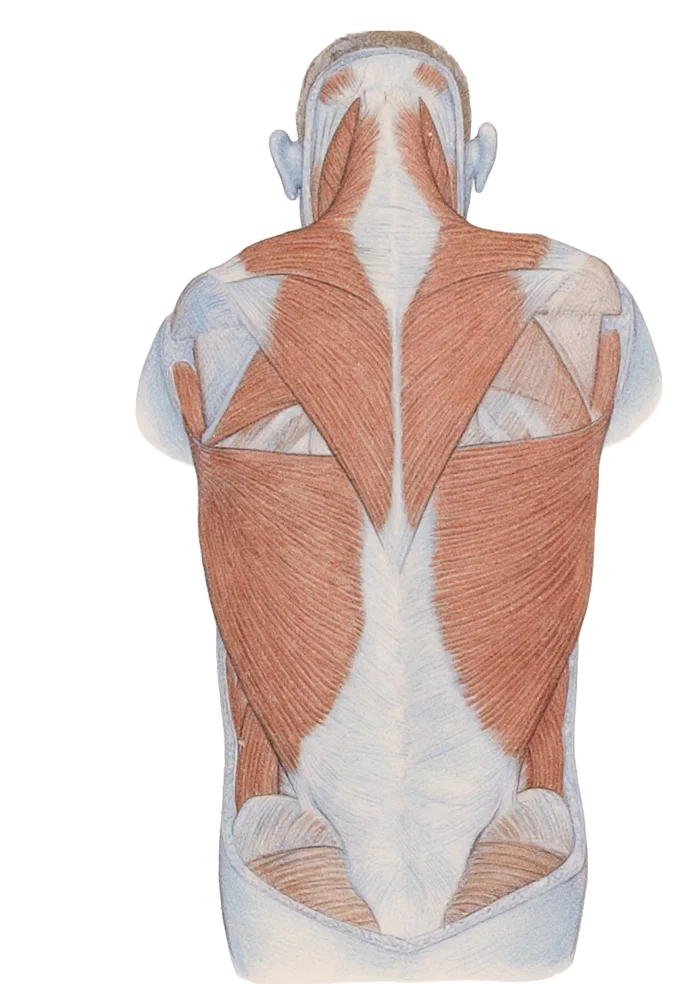
The upper back works in concert with the ribs, shoulders, neck, and diaphragm — imbalances in any of these areas can create pain and tension. Anatomy Plate (Sobotta 1909)
Whole-Body Evaluation
We start with an intake and movement assessment to identify what’s driving your upper-back tension—often restricted ribs, forward-head posture, overworked traps, or limited shoulder mechanics. These patterns frequently begin lower in the body, where unresolved ankle, knee, or hip issues force the upper back to compensate.
Targeted Myofascial & Deep Tissue Work for Immediate Relief
We start by releasing surrounding areas—like the hip flexors and neck flexors—to take pressure off the upper back. With that slack created, the second half of the session focuses on the key overload muscles—pecs, scalenes, diaphragm, serratus anterior, rhomboids, lats, and deep spinal stabilizers—so they respond to deeper work.
Progressive Plan That Builds on Each Session
Once initial tension eases, we expand into full-body integration — hips, ribs, shoulders, neck, jaw, and feet — following a Rolfing-inspired approach. This ensures the upper back isn’t forced to compensate for imbalances elsewhere and your results hold long-term.
What to Expect
A Progressive Plan
Session 1
Decompress the upper back by releasing ribs, diaphragm, chest, and shoulder stabilizers. Expect easier breathing, lighter shoulders, and reduced tension between the shoulder blades.
Sessions 2–4
Integrate shoulder, neck, and spinal mechanics while retraining rib mobility and postural balance to reduce overload on the upper back.
Sessions 5–8+
Reinforce whole-body alignment — connecting feet, knees, hips, ribs, shoulders, neck, and jaw — to maintain comfortable posture and prevent recurrence.
Ready to start feeling better?
Book a session
Care
Home Care That Helps Between Sessions
We keep it simple — no long exercise lists, just the practices that actually work.
You’ll learn techniques such as:
- Rib expansion & breathing resets
- Pec doorway openers
- Scapular glide & shoulder blade setting
- Thoracic twist stretches

Testimonial
What Our Clients Say
Pricing & wellness wallets
Book now. Pay after.
Save up to 20%.
Pay after your session—no prepay.
New here? Select “New Client Massage” to get $25 off your first visit.
Add a Wellness Wallet before your first session or within 7 days after to get up to 20% bonus credit.
START HERE
Book your session
No prepay—card on file to hold; pay after your session. New here? Choose “New Client Massage” when booking to get $25 off your first visit with select therapists.
Senior
Lead
Owner
60 minutes
$160
/ with Senior Therapist
90 minutes
$230
/ with Senior Therapist
First wallet bonus
Save with Wellness Wallets
First time buying a Wellness Wallet? You qualify for our best bonus. New to Bodyworks? Buy before your first session to use it on that visit.
$800
Get $120 bonus
Covers ~3–5 sessions
15% bonus credit
$1400
Get $250 bonus
Covers ~5–10 sessions
17.5% bonus credit
$3000
Get $600 bonus
Covers ~12–22 sessions (Annual plan)
20% bonus credit

Frequently Asked Questions
Have more questions? Get in touch
Why does my upper back hurt so much when I sit or work at the computer?
Forward-head posture and reduced rib mobility overload the thoracic spine and shoulder girdle. Treating the pecs, diaphragm, ribs, and neck usually brings significant relief.
Do I need imaging or a doctor's release before receiving massage?
No. Under NYS Title VIII licensure (see NY Board of Education FAQ #28), massage therapists can assess whether your symptoms are safe for massage. We refer out only when necessary.
What makes Bodyworks DW’s approach different?
We treat the upper back as part of the entire body system — integrating ribs, shoulders, hips, and breath mechanics — so results last instead of fading within hours.
How many sessions will I need?
Most clients feel noticeable improvement in 2–4 sessions, with longer-term structural change developing over 5–8 sessions.
Are there precautions for upper back pain massage?
Yes — recent injuries, acute inflammation, fever/illness, or medications affecting tissue integrity require caution.
Full list: NYS Massage Therapy Precautions