
Conditions We Treat
Massage for Shoulder Replacement Recovery in NYC
Regaining strength, mobility, and confidence after shoulder replacement surgery takes time—and often requires far more than isolated shoulder work. Our licensed medical massage therapists help support your recovery by improving mobility in the surrounding joints, reducing compensatory tension, and restoring natural movement patterns.
- Available in FiDi & Midtown West – open 7 days a week
Causes
What’s Going On After Shoulder Replacement?
- Shoulder replacements are highly effective—over 90% of patients report major improvement in pain and function within a year (Open Orthop J. 2011).
- Total (TSA) and reverse (rTSA) shoulder arthroplasty are common for arthritis, chronic rotator cuff tears, or traumatic injury.
- Even after successful surgery, nearby soft tissues—pecs, lats, biceps, triceps, deltoids, and rotator cuff—can remain tight or weak from long-term guarding.
- Compensation patterns in the ribs, neck, thoracic spine, and hips often persist, limiting full recovery.
- Many clients notice stiffness with overhead reach, reaching behind the back, or sleeping—often driven by tension above or below the surgical site.
At Bodyworks DW, we see shoulder-replacement recovery as a full-body reintegration process. By improving movement through the ribs, neck, spine, diaphragm, and hips, we help your new shoulder move more freely and recover more efficiently.
Related conditions: See also our Rotator Cuff Injury, Frozen Shoulder, and Upper Back Pain pages.
How we treat
What’s Going On After Shoulder Replacement?
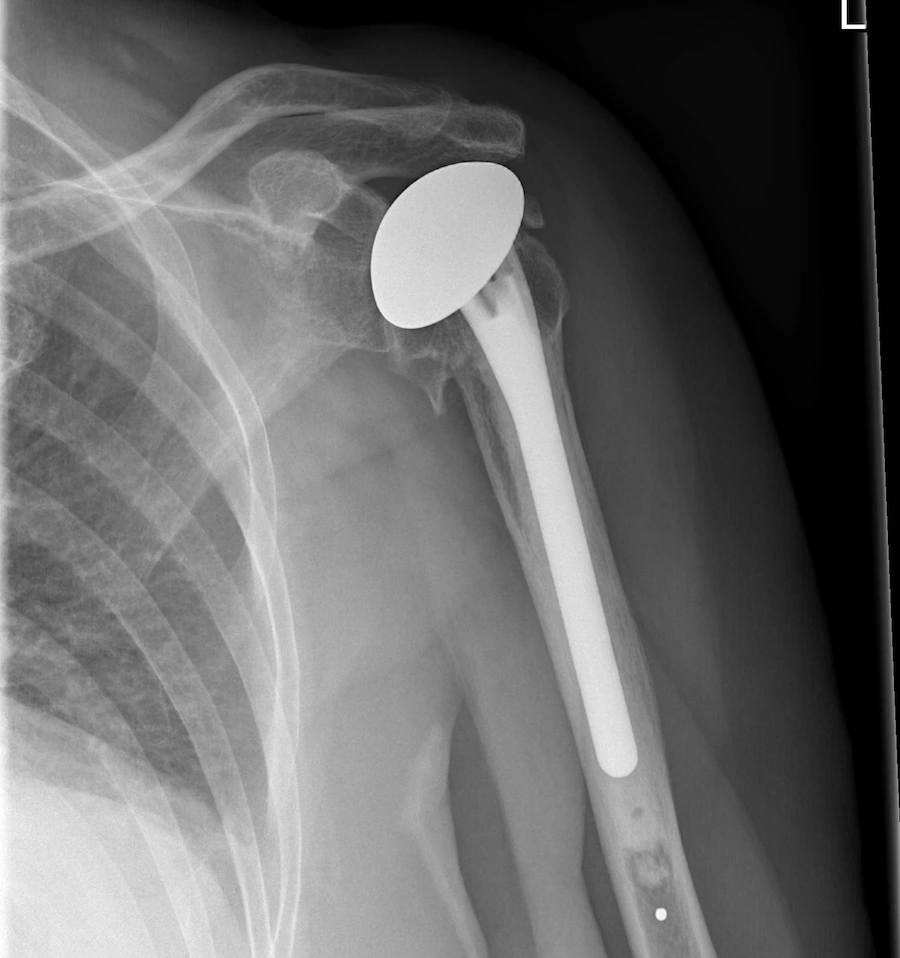
Successful shoulder replacement recovery depends on restoring balanced movement through the ribs, neck, and upper back—not just the joint itself. Public Domain Xray (Lucien Monfils 2011)
Whole-Body Evaluation
We assess rib mobility, neck tension, scapular glide, core balance, and breathing patterns to understand the forces acting on your new shoulder.
Targeted Myofascial & Deep Tissue Work for Relief
Once cleared for massage by your surgeon or PT, we begin by releasing tension in the ribs, diaphragm, pecs, lats, and upper back to create space for your shoulder to move. Local work near the surgical site is introduced gradually and always based on your healing stage.
Support for Reverse Shoulder Replacements (rTSA)
We pay special attention to deltoid coordination, rib‑cage rotation, and scapular mechanics—key factors that determine long‑term success with rTSA.
Progressive Plan That Builds on Each Session
As mobility increases, we integrate hips, spine, ribs, and shoulder‑blade motion to help you regain functional movement patterns needed for reaching, lifting, and daily activities.
We coordinate our work with your PT
As your PT rebuilds your joint stability, we safely mobilize it to make sure that it can move better in all directions without other muscles overcompensating and creating secondary issues later. We generally suggest PT 2–3x per week, supported by massage approximately once every 3 weeks during the initial 12–16 weeks post‑surgery.
What to Expect
What to Expect – A Progressive Plan
Session 1
Improve comfort by easing tension in ribs, diaphragm, chest, and upper back. Expect gentler shoulder mobility, easier breathing, and improved overall comfort.
Sessions 2–4
Restore coordinated rib, scapular, and spinal motion to support early functional gains.
Sessions 5–8+
Reinforce whole‑body alignment—from the feet up through the hips, ribs, shoulders, neck, and jaw—to help your new shoulder move with long‑term ease and stability.
Ready to start feeling better?
Book a session
Care
Home Care That Helps Between Sessions
We’ll teach simple, effective strategies such as:
- Rib‑expansion and breathing resets
- Gentle isometrics (aligned with your PT protocol)
- Scapular glide drills
- Postural awareness strategies for sitting, sleeping, and lifting
- Pec and lat mobility resets

Testimonial
What Our Clients Say
Pricing & wellness wallets
Book now. Pay after.
Save up to 20%.
Pay after your session—no prepay.
New here? Select “New Client Massage” to get $25 off your first visit.
Add a Wellness Wallet before your first session or within 7 days after to get up to 20% bonus credit.
START HERE
Book your session
No prepay—card on file to hold; pay after your session. New here? Choose “New Client Massage” when booking to get $25 off your first visit with select therapists.
Senior
Lead
Owner
60 minutes
$160
/ with Senior Therapist
90 minutes
$230
/ with Senior Therapist
First wallet bonus
Save with Wellness Wallets
First time buying a Wellness Wallet? You qualify for our best bonus. New to Bodyworks? Buy before your first session to use it on that visit.
$800
Get $120 bonus
Covers ~3–5 sessions
15% bonus credit
$1400
Get $250 bonus
Covers ~5–10 sessions
17.5% bonus credit
$3000
Get $600 bonus
Covers ~12–22 sessions (Annual plan)
20% bonus credit

Frequently Asked Questions
Have more questions? Get in touch
When can I start massage after shoulder replacement?
Typically once your surgeon or physical therapist clears you—often around 6–12 weeks depending on healing. We tailor pressure and techniques to your stage of recovery.
Is massage safe for a reverse shoulder replacement?
Yes, when performed by trained medical massage therapists. We adjust techniques to support deltoid‑driven movement and avoid stressing healing tissues.
What makes Bodyworks DW’s approach different?
We address the full kinetic chain—ribs, spine, hips, scapula, neck—not just the replaced joint. This helps your new shoulder move more naturally and reduces compensatory strain.
How many sessions will I need?
Most clients feel meaningful progress within 2–4 sessions, with deeper integration occurring over 6–10+ sessions.
Are there precautions for massage after shoulder replacement?
Yes. We avoid direct work over unhealed incisions and adjust pressure based on healing stage, inflammation, medical conditions, or medications affecting tissue integrity.
Full list: NYS Massage Therapy Precautions