When were your first sports injuries?
If you’re active now, odds are you started playing sports early. I remember my first soccer tryout at 9—and my first sprained ankle from a slide tackle at 11. Plenty more injuries followed: soccer, track, cross country, cycling, swimming, aikido… and that one ill-fated parkour class where I sprained my ankle again. I wish I had known about massage therapy for sports injuries a lot earlier.
Over the years I’ve sprained both ankles more than once, torn a hamstring twice, smashed fingers and toes, torn a rotator cuff, developed a wrist bone spur, dealt with shin splints, plantar fasciitis, hip pain, low back pain, and even herniated a disc in my neck.
How I’ve kept active despite these injuries
To keep moving, I’ve had a steady rotation of bodywork, acupuncture, physical therapy, and chiropractic care since my mid-20s. Without it, I’d probably be held together with duct tape—and I suspect a few surgeries would have been in my past by now (currently surgery-free at 50+).
Like many of you, I’ve got the scars to prove my sports history. And as we get older, those old injuries increase the odds of new ones. I’ve learned—through trial, error, and re-error—to be more cautious and keep a consistent self-care routine.

How to readjust your routine to avoid pain
Anatomy 101: How scar tissue forms
Every time we get injured—sports or otherwise—our body has to decide how to close the gap. It can rebuild with healthy, functional tissue… or it can use scar tissue. The more severe the injury, the more likely the body chooses scar tissue. If it doesn’t, you risk excess bleeding, infection, and other serious problems.
Why does this happen?
Healthy tissue takes time to build. In an emergency, your body prioritizes survival:
- Slowly rebuild with “good as new” muscle or skin and risk bleeding out, OR
- Plug the hole fast with scar tissue and keep you alive.
Spoiler: the body plays it safe. We all have scar tissue; athletes and lifelong exercisers usually have a lot more. Try listing all your injuries—you’ll see what I mean.
What makes scar tissue such an issue
Our bodies are made of functional pieces held together by fascia—a web of non-living connective tissue made mostly of water and collagen fibers. Scar tissue is also collagen-based, but the similarity ends there.
If both are made of collagen, what’s the difference?
In healthy fascia, collagen fibers are woven in an organized, fabric-like pattern. This gives your joints and muscles both support *and* elasticity. It’s like an internal ACE bandage.
Scar tissue, on the other hand, is collagen dumped into place quickly—more like a pile of pick-up sticks than a woven fabric. The body doesn’t have time to arrange it neatly; it just needs to stop the bleeding. That’s why scars feel stiff and less mobile.
Scar tissue can show up from big injuries, but also from tiny micro-tears when you push too hard. Most micro-tears heal well, but some get patched with scar tissue. Over time, those little restrictions add up.
You can’t get rid of scar tissue, but massage therapy for sports injuries can help it move again.
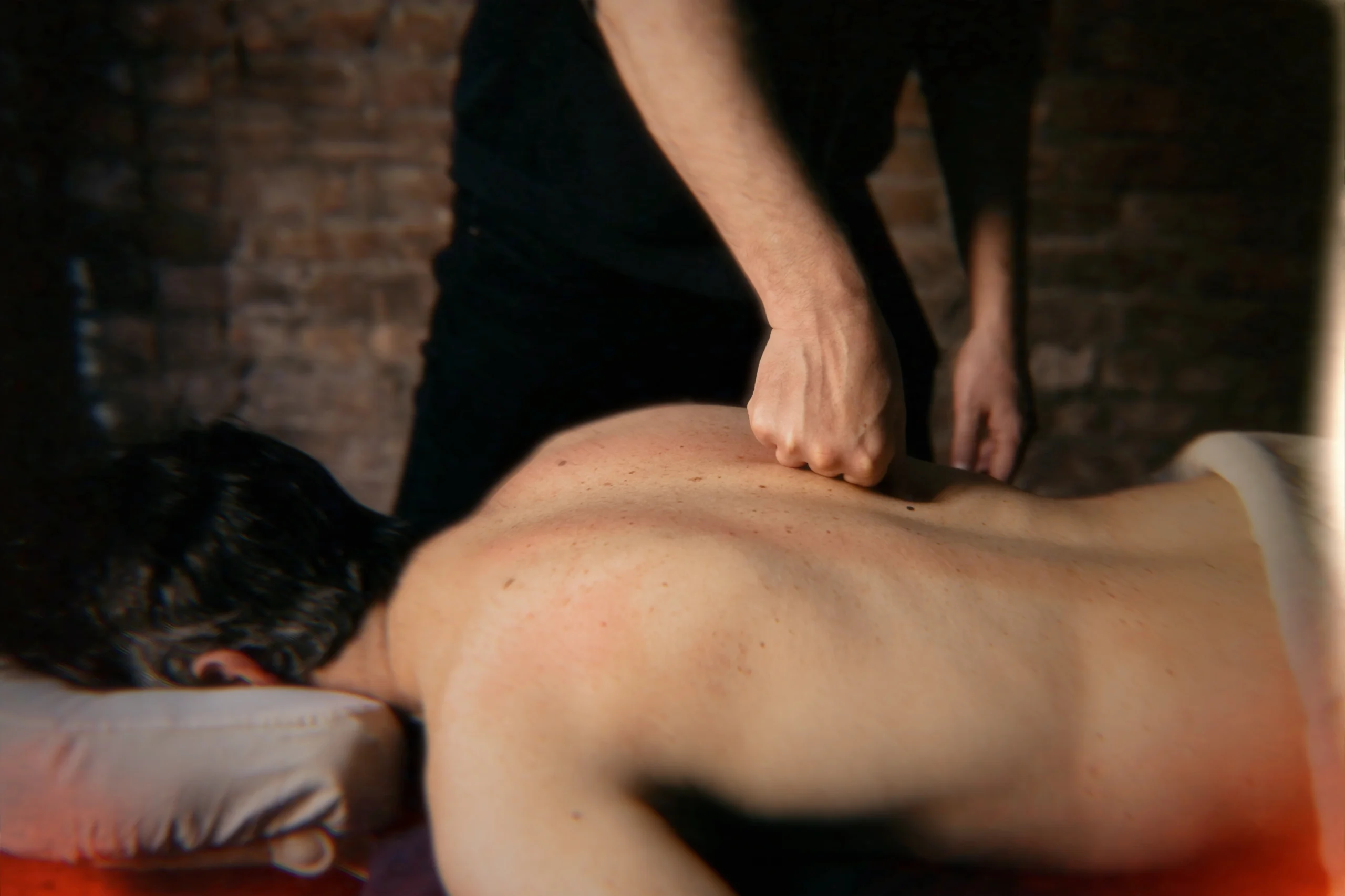
Scar tissue is permanent—but its behavior isn’t. Skilled bodywork can soften and reorganize the tissue, helping it slide and stretch more like healthy fascia. Pair that with regular stretching and mobility work and you can regain most, if not all, of your range of motion.
Here’s the really important thing:
As we age, healing slows down. That means your body is more likely to use scar tissue instead of rebuilding healthy tissue.
Want to dive deeper? The Washington Post wrote a great wellness piece on this: click here.
What can I do to prevent sports injuries as I get older?
First, we need to redefine “injury.” Every week I ask clients about past injuries and many say, “Oh, I’ve never really been injured…” Which is always interesting, because they’re coming in due to pain.
We think of injuries as broken bones or torn ligaments. Those count, sure. But the *small* ones matter too.
How micro-tears build up into major injuries
You push hard at the gym, and the next day there’s a little “tug” in your hip when climbing stairs. That’s an injury—it needs recovery. But… you don’t want to miss your workout, so you push through it.
The hip screams at the start, “warms up,” and feels better mid-workout. The next day it’s worse. Now your shoulder feels off too. And—because we are human—you go right back to the gym again anyway.
When you rely on emergency systems just to get through everyday life, what’s left for an emergency?
Your body has built-in survival tools: adrenaline (energy + confidence) and cortisol (numbs pain). These were designed for escaping bears—not for proving we “still got it” in a workout class.
Most of us overuse them to mask pain, push through injury, and ignore the emotional reality of aging.
Here’s the truth: as we age, recovery takes more time. You can still go hard—you just need to invest more in recovery and maintenance.
We don’t “bounce back” like we used to. We can either accept that… or repeatedly slam into the same wall. Your call 🙂
.jpg)
New Rules for Preventing Sports Injuries as We Age
When You Feel Pain, Stop
- If you experience sharp pain (not normal soreness) during exercise, STOP.
- Cool down with light walking, then gentle stretching or foam rolling—as long as it doesn’t trigger the pain.
- Call it a day and give yourself at least 24 hours to heal.
- Try light exercise the next day; if it’s still painful, stop again.
- Avoid exercises that recruit the injured area.
- Otherwise you’ll rip up more tissue and slow recovery.
- If your hip hurts, upper-body training might still be fine.
- Practice good post-workout care:
- 10–15 minutes of cool down and stretching.
- Fascia becomes more fluid during exercise; muscles become shorter.
- If you don’t stretch afterward, fascia stiffens around those shortened muscles.
- Get regular massage therapy for sports injuries.
- If you’re looking for sports massage in NYC, this is one of our specialties 🙂
Additional Helpful Tips
- Newer research suggests 3–4 short HIIT workouts per week (30 minutes each) are as effective as long daily runs.
- More recovery time, less overuse.
- Variety is healthiest.
- There’s a reason elite athletes do yoga, pilates, ballet, etc.
- Mix up activities you enjoy.
- Runners and cyclists can vary pace, distance, hills, and intervals.
- A hot shower or bath after a workout is fantastic for circulation.
- Bonus: finish with 30 seconds of cold.
- Hot = vessels open (flush waste out).
- Cold = vessels contract (pump metabolic byproducts out).
- Alternating acts like a recovery pump.
- If sharp pain persists for several days, see a trained sports massage therapist or medical professional.
- A good practitioner can often get you back to training quickly.
- Waiting too long usually means more sessions—and more time off.
If you follow these guidelines and build more self-care into your routine, you’ll feel better, move better, and be far less likely to get sidelined. A “less is more” mindset often leads to better results with less time wasted.
Here at Bodyworks DW Advanced Massage Therapy, our therapists are highly trained in sports injury recovery. We can assess your alignment, identify whether old injuries are affecting new ones, and determine when you may need additional care from a PT or orthopedic specialist. Book a sports massage in FiDi or Midtown and let’s get you moving well again.